 English
 中文简体
中文简体 日本語
日本語 русский
 عربى
عربى Український
 Español
 Français


From Batter to Fortune: How Automatic Fortune Cookie Production Lines Are Transforming Traditional Baking
Content
- 1. Introduction: Small Cookie, Big Industry
- 2. What Is an Automatic Fortune Cookie Production Line?
- 3. The Core Production Process
- 4. Key Equipment and Technologies
- 5. Key Advantages of Automation
- 6. Buying Guide: How to Choose a Production Line
- 7. Daily Operation, Maintenance, and Troubleshooting
- 8. Industry Trends and Outlook
- 9. Conclusion
1. Introduction: Small Cookie, Big Industry
A fortune cookie weighs only a few grams, yet it sits at the center of a surprisingly large global business. It ends up in restaurants, supermarkets, event gift bags, and branded promotional boxes. Behind every crisp, folded cookie with a slip of paper inside is a process that was once almost entirely manual.
Traditionally, fortune cookies had to be shaped by hand within seconds of leaving the oven, while the dough was still hot and pliable. That works for a small bakery, but it becomes a bottleneck once demand grows. This is why more manufacturers are investing in an automatic fortune cookie production line: a coordinated system that turns batter into finished, fortune-filled cookies with consistent quality and far less labor.
This article walks through how these lines work, what equipment they include, what benefits they offer, and how to choose and maintain one.
2. What Is an Automatic Fortune Cookie Production Line?
An automatic fortune cookie production line is an integrated set of machines that handles the full process: mixing batter, depositing it onto baking plates, baking, inserting the fortune slip, folding, cooling, and in many cases, counting and packaging.
The key difference from semi-automatic or manual setups is the folding step. Because the cookie must be folded while hot and flexible, the timing between baking and folding is critical. Automatic systems solve this with mechanical folding arms or molds synchronized with the oven’s movement, so every cookie is folded at the right moment, in the same way, every time.
Production lines range from compact machines for small and mid-sized bakeries to large-scale, continuous systems designed for industrial food factories. Output capacity, level of automation, and customization options vary widely between manufacturers.
3. The Core Production Process
While specific designs differ, most automatic lines follow the same sequence of stages:
Batter preparation. Flour, sugar, eggs, oil, water, and flavorings are mixed into a smooth, flowing batter. Consistency matters here: batter that is too thick or too thin will affect cookie thickness, color, and foldability.
Depositing. A pump and dosing system measures precise portions of batter onto heated baking plates or molds. Accurate dosing keeps cookie size and weight uniform.
Baking. The plates travel through a tunnel or rotating oven. Temperature and baking time are tightly controlled so the cookie sets into a thin, golden disc that remains flexible for a short window.
Fortune insertion. A paper slip is placed onto the hot disc by a feeding mechanism, usually fed from a roll or stack of pre-cut strips.
Folding and shaping. The disc is folded into the classic crescent shape, then bent over a rounded edge. This is the most technically demanding step and the one automation improves most.
Cooling and setting. Folded cookies pass through a cooling section, where they harden and hold their shape.
Packaging. Finished cookies are sorted, counted, and packed individually or in bulk, often into flow-wrap or tray packaging.
4. Key Equipment and Technologies
A complete line typically combines several modules:
- Batter mixing and storage system: Stainless steel mixers and holding tanks keep batter homogeneous and food-safe.
- Dosing/depositing unit: Precision pumps or piston depositors control portion size.
- Oven and baking plates: Gas- or electric-heated ovens with zoned temperature control help produce even color. Non-stick plate coatings reduce sticking and cleaning time.
- Fortune slip feeder: Handles paper insertion at the right moment and position. Some systems support custom printing or branded slips.
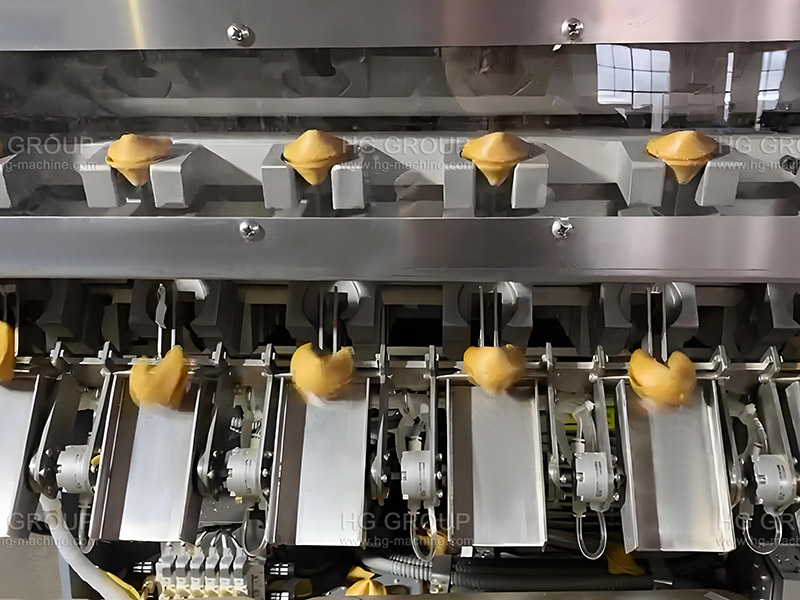
- Folding mechanism: Mechanical arms, rollers, or mold systems that fold the hot cookie into shape.
- Cooling conveyor: Controlled airflow helps cookies set without cracking.
- PLC and touchscreen control: A programmable logic controller lets operators adjust speed, temperature, and timing, store recipes, and monitor production in real time.
- Sensors and safety features: Detect jams, missing slips, or temperature deviations and stop the line when needed.
Modern lines increasingly add vision inspection to catch broken or misshapen cookies, and data logging to track output and downtime.
5. Key Advantages of Automation
Higher and more stable output. A continuous line runs for long shifts at a steady pace, something hand folding cannot match.
Consistent quality. Uniform size, color, shape, and crispness make a better product and reduce rejects, which is especially important for retail and export customers.
Lower labor dependence. Hand folding requires fast, skilled workers and is physically repetitive. Automation reduces the number of operators needed and the risk of staffing shortages disrupting production.
Improved hygiene. Fewer hands on the product means lower contamination risk, and stainless steel construction supports easier cleaning and compliance with food safety standards.
Better cost control. Precise dosing reduces batter waste, and consistent baking lowers scrap rates. Over time, these savings, combined with higher volume, improve per-unit cost.
Flexibility and branding. Many lines support different flavors, sizes, and custom fortune slips, helping manufacturers serve private-label customers and seasonal markets.
6. Buying Guide: How to Choose a Production Line
Choosing the right machine is less about finding the biggest or cheapest option and more about matching the line to your business.
- Define your capacity needs. Estimate current demand and realistic growth over the next few years. Buying slightly above current needs leaves room to expand, but oversizing wastes capital.
- Check the folding performance. Ask for a live demonstration or video of the line running at full speed. Look at the fold quality, the rate of broken cookies, and how reliably fortunes are inserted.
- Evaluate build quality and materials. Food-contact parts should be stainless steel, with smooth welds and easy-to-clean surfaces.
- Consider energy type and consumption. Gas and electric ovens differ in running cost and local availability. Compare efficiency, not just purchase price.
- Look at the control system. An intuitive touchscreen, recipe storage, and clear fault alerts shorten training time and reduce errors.
- Ask about flexibility. Can the line handle different cookie sizes, flavors, or colored batters? Can fortune slip formats be changed easily?
- Confirm compliance and certifications. Depending on your market, you may need CE, ISO, or other food-machinery certifications.
- Review after-sales support. Installation, operator training, spare parts availability, and response time matter as much as the machine itself. Ask for references from existing customers.
- Calculate total cost of ownership. Include installation, utilities, maintenance, consumables, and expected downtime, not only the purchase price.
7. Daily Operation, Maintenance, and Troubleshooting
Daily routines. Before each shift, inspect baking plates, check batter viscosity and temperature, confirm the fortune feeder is loaded correctly, and run a few test cycles. At the end of the shift, clean batter residue from plates, pumps, and conveyors to prevent buildup and cross-contamination.
Regular maintenance. Follow the manufacturer’s schedule for lubricating chains and bearings, checking belt tension, inspecting heating elements or burners, and calibrating sensors. Keep a log so recurring issues are easy to spot.
Common problems and fixes:
- Cookies cracking during folding: Often caused by baking too long, or by a delay between baking and folding. Adjust oven time or temperature and check synchronization.
- Cookies sticking to plates: Check plate coating condition, batter oil content, and plate temperature.
- Uneven color or thickness: Look for inconsistent dosing, uneven heat distribution, or worn plates.
- Missing or misplaced fortune slips: Inspect the feeder, paper quality, and sensor alignment. Humidity can cause slips to stick together.
- Frequent jams: Review batter consistency and clean the folding mechanism thoroughly.
Training matters. Well-trained operators catch small deviations early, which prevents costly shutdowns and wasted product.
8. Industry Trends and Outlook
Several trends are shaping the next generation of fortune cookie equipment:
- Smarter control and data. Connected lines that track output, energy use, and faults help managers optimize production and plan maintenance before breakdowns occur.
- Customization at scale. Brands increasingly want personalized messages, special flavors, and unique shapes for events and campaigns, pushing demand for flexible lines with quick changeovers.
- Product diversification. Beyond the classic vanilla cookie, there is growing interest in chocolate-dipped, gluten-free, plant-based, and reduced-sugar variations.
- Energy efficiency and sustainability. Better insulation, heat recovery, and efficient ovens reduce operating costs, while the industry looks for more eco-friendly packaging.
- Integrated packaging. Lines that connect directly to counting, wrapping, and boxing systems reduce handling and speed up delivery.
As consumer interest in novelty snacks and experiential food continues, automation will help producers scale without sacrificing the charm that makes fortune cookies appealing.
9. Conclusion
The fortune cookie may be a humble treat, but making it at scale takes precision engineering. An automatic fortune cookie production line replaces fragile, labor-intensive hand folding with a repeatable, hygienic, and efficient process. For manufacturers, the benefits are clear: higher output, consistent quality, and greater flexibility to meet changing market demands.
Success, however, depends on choosing the right line, training your team, and maintaining the equipment well. With the right investment and planning, a traditional baking craft can grow into a reliable, modern production business, one batch, and one fortune, at a time.
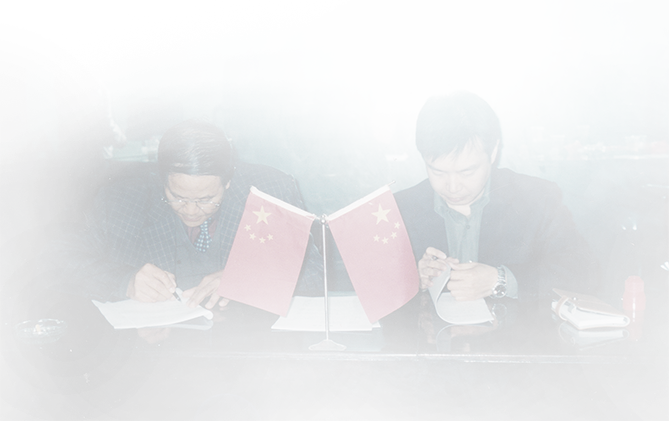
A historic signing moment from the 1970s, when HG’s founder helped drive the development of China’s food industry and began expanding into international markets.
Over the past decades, we have participated in the evolution of automated food production — from local factories to global turnkey projects across 100+ countries. That experience continues to shape every HG production line today.
Discover Our Heritage
Global Food Machinery &
Turnkey Factory Solutions

Building Long-Term Partnerships Through Shared Growth and Industrial Value.
Copyright © HG Industry Group All Rights Reserved
Food Machine Snack Food Processing Machinery

Unauthorized use of this website's content constitutes copyright infringement and may result in legal action.