 English
 中文简体
中文简体 日本語
日本語 русский
 عربى
عربى Український
 Español
 Français
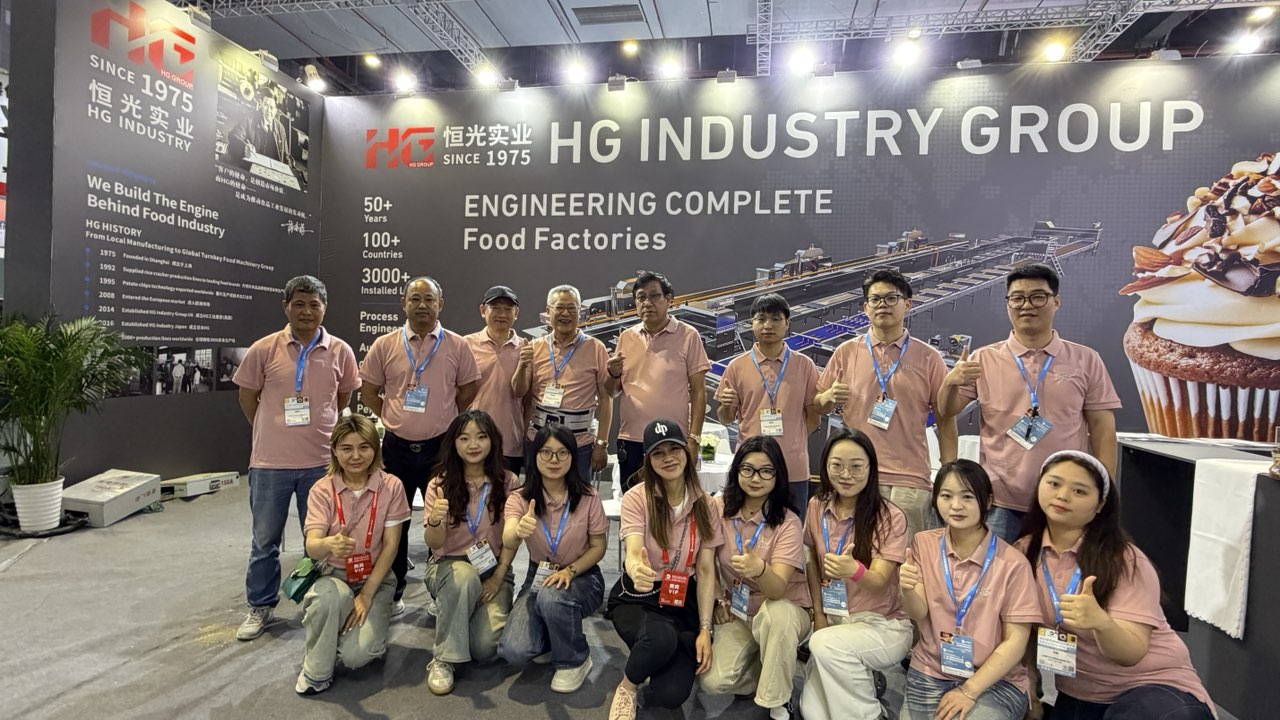


Fresh-Cut & Natural Potato Chips Production Line: From Raw Potato to Bagged Chip
Content
- 1.Why Raw Potato Selection Determines Your Line's Success
- 2.The Full Process Flow From Raw Potato to Bagged Chip
- 3.Slicing Precision and Why Thickness Consistency Matters
- 4.Frying System Choices and Their Impact on Final Product
- 5.Matching Line Capacity to Your Business Size
- 6.Reducing Waste and Oil Costs on a Running Line
- 7.Quality Checks Worth Running on Every Shift
Potato chips remain one of the most consistently profitable snack categories in the world, but the difference between a line that makes money and one that bleeds it usually comes down to decisions made long before the first bag is sealed. This guide walks through what actually matters when building or upgrading a fresh-cut, natural-style potato chips production line — from selecting raw potatoes to catching quality issues before they leave the factory.
1.Why Raw Potato Selection Determines Your Line's Success
No amount of good equipment can fix a bad batch of potatoes. Raw material selection is the single biggest variable in chip quality, and it starts with three properties: dry matter content, sugar level, and tuber size uniformity.
- Dry matter (starch content): Potatoes with 20–24% dry matter fry crisper and absorb less oil. Low dry matter potatoes produce limp, greasy chips no matter how well the fryer is tuned.
- Reducing sugar levels: High sugar content causes dark, bitter chips due to the Maillard reaction during frying. Varieties like Atlantic, Lady Rosetta, or Shepody are popular precisely because they hold low sugar levels after storage.
- Storage temperature: Potatoes stored below 7°C undergo "cold sweetening," where starch converts to sugar. Chip-grade potatoes should generally be held between 8–12°C, not standard cold storage temperatures used for table potatoes.
- Size and shape uniformity: Round-to-oval tubers of a consistent diameter reduce slicing waste and give more uniform chip shapes, which matters for both yield and visual appeal on shelf.
A line running well-selected potatoes will consistently need less rework, less oil replacement, and fewer downgraded batches — the raw material decision pays for itself at every downstream stage.
2.The Full Process Flow From Raw Potato to Bagged Chip
A standard fresh-cut, natural potato chips line follows this sequence:
- Receiving & storage – Potatoes are held in curing/storage bins at controlled temperature and humidity to stabilize sugar content before processing.
- Washing & stone removal – A rotary drum washer or bubble washer removes dirt, and a destoner separates rocks and debris that could damage slicing blades.
- Peeling – Abrasive roller peelers or steam peelers remove skins. Steam peeling is gentler and reduces water usage, though abrasive peeling is more common for cost-sensitive lines.
- Inspection & trimming – Workers or optical sorters remove potatoes with green spots, sprouts, or defects, and trim eyes.
- Slicing – Centrifugal or gravity slicers cut potatoes into uniform rounds, typically 1.2–2.0 mm thick.
- Rinsing / starch washing – Sliced potatoes pass through a rinse tank to remove surface starch, which prevents slices from sticking together and reduces oil discoloration during frying.
- Blanching (optional) – Some natural-style lines skip blanching to preserve a more "raw-fried" texture and flavor; others use a brief hot water blanch to control sugar and set color.
- De-watering – Vibrating screens or air-knife dryers remove surface moisture before frying, which is critical for oil life and frying safety.
- Frying – Continuous fryers cook the slices, typically at 165–185°C, with frying time adjusted to slice thickness and desired moisture content.
- De-oiling – Centrifugal de-oiling or vibrating screens remove excess surface oil immediately after frying.
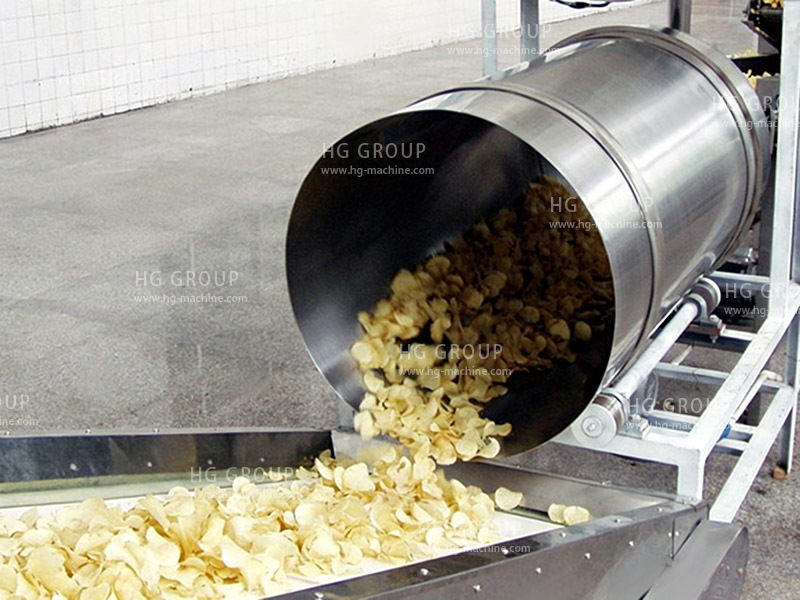
- Seasoning – A rotating seasoning drum applies salt or flavor powders while chips are still warm enough for the seasoning to adhere.
- Cooling – Chips are cooled to room temperature before packaging to prevent condensation inside the bag.
- Inspection & metal detection – Optical sorters and metal detectors remove burnt, broken, or contaminated chips.
- Weighing & bagging – Multihead weighers and vertical form-fill-seal (VFFS) machines portion and seal bags, often under nitrogen flush to extend shelf life.
Each stage feeds directly into the next, so a bottleneck or quality miss early in the line compounds by the time product reaches the bagger.
3.Slicing Precision and Why Thickness Consistency Matters
Slicing is where fresh-cut chip quality is largely decided, and thickness consistency is the metric that matters most.
A variance of even ±0.2 mm across a batch creates uneven frying: thinner slices burn while thicker ones stay undercooked in the same fryer residence time. This produces a mixed batch that has to be manually sorted or, worse, gets shipped and generates customer complaints.
Key factors in slicing precision:
- Blade sharpness and maintenance schedule – Dull blades tear rather than cut, creating rough edges that fry unevenly and absorb more oil. Most operations schedule blade replacement or sharpening every 4–8 hours of continuous run time, depending on throughput.
- Feed rate control – Centrifugal slicers must maintain a steady potato feed; surges cause slices to be cut at an angle or unevenly.
- Crinkle vs. straight-cut blades – Crinkle-cut chips have more surface area, which affects both frying time and seasoning adhesion, so blade selection should match the target product spec, not just aesthetics.
- Slice thickness adjustment – Look for slicers with tool-free or digital thickness adjustment, since product lines that run multiple SKUs (regular vs. thick-cut) need fast changeover without stopping the line for extended mechanical resets.
Investing in a slicer with tight tolerance control typically pays back through reduced fryer energy waste and fewer downgraded batches — it's a smaller line item than the fryer, but it disproportionately affects finished product consistency.
4.Frying System Choices and Their Impact on Final Product
The fryer is the highest capital-cost and highest operating-cost component on most chip lines, and the type selected shapes both product character and ongoing economics.
Batch fryers suit small-to-mid volume or artisanal/kettle-style chip production. They allow more manual control over frying time and are often used for "natural" or "kettle-cooked" positioning, where uneven browning and thicker cuts are part of the product identity.
Continuous fryers are standard for higher-volume lines. Chips move through the oil on a mesh conveyor, giving consistent frying time across the batch. Sub-types include:
- Standard continuous fryers – straightforward oil bath frying, most common for classic thin-cut chips.
- Vacuum fryers – fry at lower temperature under reduced pressure, which produces lighter color, less oil absorption, and is often used for "healthier" or fruit/vegetable chip lines.
- Low-oil / centrifugal fryers – incorporate an oil-spinning step to reduce final oil content, popular for chips marketed on a lower-fat claim.
Other frying system factors worth evaluating:
- Heating method – Direct-fire, indirect (heat exchanger), or thermal-oil heating systems each have different energy efficiency and temperature-control characteristics; indirect and thermal-oil systems generally give more even, controllable frying.
- Oil filtration integration – Fryers with continuous or semi-continuous oil filtration extend oil life significantly and reduce the buildup of fine particles that darken oil and shorten its usable lifespan.
- Automatic temperature/PID control – Precise temperature control reduces batch-to-batch color variation, which matters both for quality consistency and for meeting acrylamide-reduction guidance that regulators in several markets now reference for fried potato products.
The fryer choice should be made against the target product positioning first (natural kettle-style vs. classic thin-cut vs. reduced-oil), and against volume second — the wrong-sized fryer for your throughput either bottlenecks the line or runs inefficiently under capacity.
5.Matching Line Capacity to Your Business Size
Buying more capacity than a business needs ties up capital and leaves equipment running well under its efficient operating range; buying too little forces a costly early upgrade. Rough capacity tiers commonly seen in the industry:
- Small / pilot scale: 50–150 kg/h finished chips — suited to a single retail brand, farm-to-shelf operations, or a business still validating product-market fit.
- Small-commercial: 150–500 kg/h — typical for regional snack brands supplying a defined distribution area.
- Mid-scale: 500 kg/h – 1.5 t/h — supports multi-region distribution and private-label contracts.
- Large industrial: 1.5 t/h and above — national or export-oriented operations, usually running multiple parallel fryer lines rather than a single larger fryer, for redundancy and flexibility across SKUs.
Beyond raw throughput numbers, capacity planning should account for:
- Seasonal demand swings – Snack sales often spike around holidays; a line sized only for average demand may not handle peak season without overtime or missed orders.
- SKU diversity – Multiple flavors, cuts, or package sizes reduce effective throughput due to changeover time; a line running many SKUs may need to be sized above the raw output requirement to account for changeover losses.
- Growth runway – Modular line design (equipment sized to allow a second parallel fryer or additional bagging lane later) is usually a better capital decision than over-building capacity upfront, especially for newer brands.
6.Reducing Waste and Oil Costs on a Running Line
Oil is typically the largest recurring input cost after raw potatoes, and waste reduction across the line compounds savings significantly over a year of operation.
- Oil filtration and turnover management – Continuous filtration removes fine particulates and free fatty acids that accelerate oil breakdown. Regularly monitoring oil quality (color, free fatty acid level, foam behavior) rather than replacing oil on a fixed calendar schedule avoids both premature dumping and over-used, degraded oil.
- Top-up vs. full-replacement strategy – Many efficient operations top up oil continuously rather than fully draining and replacing, which keeps oil quality stable and reduces total oil consumption per kilogram of chips produced.
- De-oiling step efficiency – A properly tuned centrifugal or vibrating de-oiler immediately after frying removes surface oil before it soaks further into the chip, directly reducing oil carried out in the finished product (and therefore oil consumed per batch).
- Potato-to-chip yield tracking – Peeling loss, trim loss, and broken-chip rate should be tracked by shift. A peeler running too aggressively, or a slicer producing excess fines, can quietly erode yield by several percentage points without an obvious single failure point.
- Water and energy recovery – Heat exchangers on fryers, and water recycling in wash/rinse stages, reduce utility costs that scale directly with production volume.
- Broken chip and fines recovery – Fines and broken chips can often be redirected to secondary products (chip dust for seasoning bases, or repackaged as a lower-grade SKU) rather than pure waste.
Waste reduction on a running line is rarely about one dramatic fix — it's usually the cumulative effect of tracking yield at each stage and correcting small inefficiencies before they become fixed costs baked into the operation.
7.Quality Checks Worth Running on Every Shift
Consistent quality control at the shift level catches problems before they scale into full-batch losses or, worse, customer-facing complaints. A practical shift checklist includes:
- Moisture content spot-checks – Finished chips should fall within a target moisture range (commonly around 1.5–2%); moisture drifting outside spec signals a fryer temperature or timing issue.
- Oil quality readings – Free fatty acid level and color should be checked at set intervals, not just when oil visibly darkens.
- Slice thickness sampling – Pulling samples from the slicer output confirms the blade is holding tolerance through the shift, not just at startup.
- Color/browning consistency – Visual or optical sorter data comparing chip color against a reference standard helps catch fryer temperature drift early.
- Salt/seasoning application rate – Seasoning drums should be checked for consistent application weight per batch; under- or over-seasoning is a common and easily corrected quality slip.
- Metal detector and foreign material checks – Metal detector calibration should be verified at the start of each shift using test pieces, per standard food safety protocol.
- Bag seal integrity – Random seal-strength or leak testing on finished bags protects shelf life and prevents returns from broken seals.
- Weight compliance – Random weight checks against the multihead weigher's target ensure packages meet declared net weight requirements.
Running these checks as a standing shift routine — rather than only during formal audits — is what separates lines with a stable reputation for consistency from lines that experience periodic quality complaints traced back to a single missed variable.
A fresh-cut, natural potato chips production line succeeds or struggles based on decisions made at every stage of this chain, not any single piece of equipment. Getting raw potato selection right, controlling slicing tolerance, matching the fryer system to product positioning, sizing capacity to real demand, and running disciplined shift-level quality checks together determine whether a line delivers consistent, profitable output — or a stream of avoidable losses.
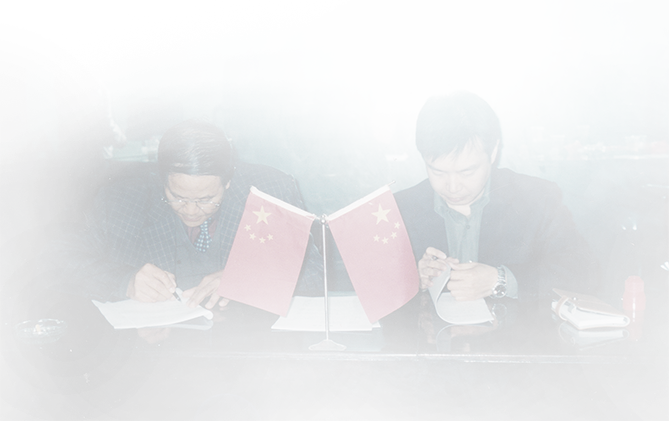
A historic signing moment from the 1970s, when HG’s founder helped drive the development of China’s food industry and began expanding into international markets.
Over the past decades, we have participated in the evolution of automated food production — from local factories to global turnkey projects across 100+ countries. That experience continues to shape every HG production line today.
Discover Our Heritage
Global Food Machinery &
Turnkey Factory Solutions

Building Long-Term Partnerships Through Shared Growth and Industrial Value.
Copyright © HG Industry Group All Rights Reserved
Food Machine Snack Food Processing Machinery

Unauthorized use of this website's content constitutes copyright infringement and may result in legal action.