 English
 中文简体
中文简体 日本語
日本語 русский
 عربى
عربى Український
 Español
 Français


How a Rice Cracker Production Line Works — And How to Set One Up Right
Content
- What a Rice Cracker Production Line Actually Handles
- Rice Cracker Types and How They Shape Line Configuration
- The Full Production Process, Stage by Stage
- Key Equipment Comparison by Line Type
- What to Evaluate When Selecting a Rice Cracker Line
- Capacity Planning for Rice Cracker Manufacturing
- Common Mistakes to Avoid When Setting Up a Rice Cracker Line
- Conclusion
Rice crackers are one of the fastest-growing snack categories globally, moving well beyond their traditional Asian markets into mainstream retail in North America, Europe, and the Middle East. For manufacturers entering this space — or scaling up existing output — understanding what a rice cracker production line actually involves is the foundation of every investment decision. This guide covers the full process, the key equipment at each stage, the differences between product types, and what separates a high-performing line from one that falls short at scale.
What a Rice Cracker Production Line Actually Handles
A rice cracker making line is an integrated sequence of machines that transforms raw rice — or rice flour — into finished, packaged snacks with consistent texture, shape, and flavor. Unlike cookie or biscuit lines that typically start with pre-milled flour, rice cracker manufacturing often begins with whole grain rice, which needs to be soaked, steamed, and kneaded into a workable dough before forming can begin. That upstream processing is what gives rice crackers their distinctive dense-then-puffed texture and is the primary reason why rice cracker equipment differs substantially from other snack food machinery.
A fully automatic rice cracker production line handles the entire process — from raw grain intake through milling, forming, drying, baking or puffing, seasoning, and final packaging — with minimal manual intervention. Standard industrial capacities range from 2.5 tons per day for smaller facilities up to 20 tons per day for large-scale commercial operations, depending on line configuration and product type.
Rice Cracker Types and How They Shape Line Configuration
Not all rice crackers are made the same way, and the product type you intend to produce determines your line's core equipment configuration before a single machine is purchased. The three main categories — senbei, arare/okaki, and puffed/extruded crackers — each require a distinct processing approach.
Senbei (Flat, Non-Glutinous Rice Crackers)
Senbei are made from non-glutinous rice (uruchimai) and are characterized by their flat disc shape and hard, crispy texture. The production process involves soaking and steaming the rice to gelatinize the starch, kneading it into a dense dough, pressing or rolling it into thin sheets, cutting into discs, drying to reduce moisture content, and then baking or grilling. Savory varieties are typically brushed with soy sauce and mirin during or after baking. Because senbei dough is stiff and requires significant pressing force, the forming equipment on these lines uses hydraulic or mechanical press-type molds rather than soft-dough extruders.
Arare and Okaki (Glutinous Rice Crackers)
Arare and okaki are both produced from glutinous rice (mochigome), which creates a chewier, more puffed texture when baked or fried. The key difference is size: okaki are larger irregular pieces, while arare are small bite-sized pieces often sold in mixed snack packs. The production process for these varieties involves steaming glutinous rice, compressing it into mochi-like blocks, cooling and aging the blocks to reduce moisture, cutting into target shapes, then drying and baking or frying. The aging and drying phase is particularly critical — moisture content at the entry to the baking stage directly determines the degree of puffing and the final cracker density.
Puffed and Extruded Rice Crackers
The third major category uses extrusion technology — typically twin-screw extruders — to process rice flour under heat and pressure, causing rapid expansion at the die exit. These "puffed" crackers have a lighter, more airy texture and are increasingly popular in Western markets as a lower-calorie snack alternative. Extruded lines differ fundamentally from traditional senbei lines: rather than a steaming-and-pressing sequence, they feed dry or semi-dry rice flour directly into the extruder, which handles cooking and forming simultaneously. This makes extruded lines faster to operate and easier to reconfigure for different shapes, but they produce a different textural profile than traditional formed-and-baked crackers.
The Full Production Process, Stage by Stage
Understanding each processing stage in a rice cracker line helps you evaluate equipment specifications against your actual production requirements — not just the headline output numbers.
Washing and Soaking
Raw rice is first conveyed to washing machines that remove surface dust and impurities. The cleaned rice is then soaked in water for a controlled period — typically 4 to 8 hours depending on variety and ambient temperature — to allow moisture absorption into the grain interior. Soaking time and water temperature directly affect starch hydration, which in turn affects the ease of steaming and the texture of the final cracker. Automated soaking tanks with timer-controlled drainage allow consistent hydration across production batches.
Steaming and Kneading
Soaked rice enters continuous steam cookers where heat converts beta-starch to alpha-starch — the gelatinized form that gives rice dough its cohesive, workable texture. Industrial steam cookers operate at controlled pressure and temperature to ensure complete and uniform gelatinization throughout the grain. The steamed rice is then fed into kneading or mixing machines that work it into a homogeneous dough. Under-kneaded dough produces crackers with inconsistent density and surface cracking; over-working generates excess heat that can degrade starch structure. PLC-controlled kneading time and torque monitoring help maintain consistency across long production runs.
Cooling and Forming
Hot dough must be cooled before forming — both to allow the starch structure to stabilize and to reach the correct viscosity for clean pressing or cutting. Cooling conveyors or refrigerated chambers bring dough temperature down to the target range, typically 20–35°C depending on product type. Forming equipment then shapes the dough into the target geometry: hydraulic press molds for flat senbei discs, extrusion and cutting systems for arare pieces, or rotary molds for shaped varieties. Mold precision at this stage determines dimensional consistency of the final product, which affects both visual uniformity on the retail shelf and evenness of baking in the next stage.
Drying
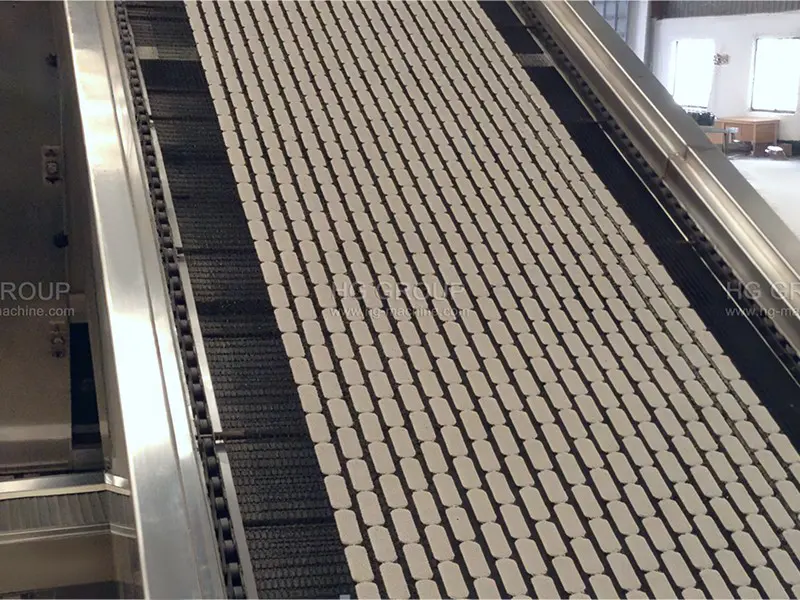
Formed pieces contain significant residual moisture that must be removed before baking or puffing. Industrial drying tunnels or multi-stage chamber dryers apply controlled heat and airflow over an extended dwell time — often 4 to 12 hours for traditional senbei — to reduce moisture content to the target level, typically 10–15% before baking. Drying is one of the most time-sensitive and energy-intensive stages in the line. Insufficient drying leaves too much moisture for proper puffing; over-drying creates surface cracking and brittleness before the product even reaches the oven. Multi-zone dryers with independently adjustable temperature and humidity settings give operators precise control over the drying curve.
Baking, Frying, or Puffing
This is the stage where crackers achieve their final texture, and the method chosen determines both product character and equipment requirements.
- Baking:Tunnel ovens with infrared or convection heating bake crackers at 200–280°C. Multi-zone temperature control allows operators to manage surface browning and internal moisture evaporation independently. Gas-fired ovens are common for energy efficiency at high volumes; electric ovens offer more precise zone control for specialty products.
- Frying:Continuous fryers cook crackers in oil at 170–190°C, producing the puffed, airy texture characteristic of age senbei and many arare varieties. Oil quality management — continuous filtration and temperature monitoring — is critical for consistent color and flavor, and for controlling oil absorption per piece.
- Hot-air puffing:Used for lower-fat puffed crackers, this method uses high-velocity hot air jets to rapidly expand pieces without oil submersion. The process is faster than oven baking and produces a very light, airy texture suitable for "baked, not fried" product positioning.
Seasoning
Immediately after cooking, crackers pass through seasoning systems while still warm, which improves adhesion of sauces and powders. Liquid seasoning (soy sauce, teriyaki glaze, chili oil) is applied by spray or roller coating systems; powder seasoning (salt, seaweed, cheese, wasabi) is applied in tumble drum coaters. For soy sauce varieties, a secondary re-baking or infrared drying stage fixes the glaze and caramelizes the coating. Seasoning uniformity across the full production volume is one of the most common pain points on high-speed lines — inconsistent coating is immediately visible to consumers and is a leading cause of product complaints and retailer returns.
Inspection and Packaging
Modern rice cracker lines integrate optical inspection cameras that detect broken pieces, color defects, and undersized crackers before packaging. Rejected pieces are diverted automatically, reducing manual sorting labor. Accepted product flows to packaging machines — typically vertical form-fill-seal (VFFS) units for pillow bags or horizontal flow wrappers for individually wrapped portions. Nitrogen flushing displaces oxygen inside the package to extend shelf life and maintain crispness. Checkweighers and metal detectors operate inline as mandatory food safety and weight compliance checkpoints.
Key Equipment Comparison by Line Type
The table below shows how equipment configuration differs across the three major rice cracker product categories.
|
Process Stage |
Senbei Line |
Arare / Okaki Line |
Extruded Puffed Line |
|
Raw Material |
Non-glutinous rice |
Glutinous rice (mochigome) |
Rice flour (dry or semi-dry) |
|
Forming Method |
Hydraulic press / roller |
Block cutting / aging |
Twin-screw extruder + die |
|
Drying Required |
Yes — multi-stage, 4–12 hrs |
Yes — aging + drying |
Minimal (post-extrusion) |
|
Cooking Method |
Tunnel oven / infrared grill |
Oven or continuous fryer |
Extrusion heat + hot air |
|
Line Complexity |
High |
High |
Moderate |
|
Typical Capacity |
2.5–12 tons/day |
2.5–10 tons/day |
100–500 kg/hr |
What to Evaluate When Selecting a Rice Cracker Line
Equipment selection for a rice cracker manufacturing line requires looking past the rated capacity numbers to the operational variables that determine actual performance.
- Dryer performance and zone control:Since drying is the longest and most energy-intensive stage, evaluate dryers by moisture uniformity across the belt width, not just drying time. A dryer with independent temperature and airflow control in 4–6 zones outperforms a single-zone dryer of the same rated capacity in real production conditions.
- Forming precision and changeover time:Mold and die systems should produce consistent piece weight and dimensions across the full production run. Equally important is how quickly the line can be reconfigured for different shapes or sizes — quick-release mold systems reduce changeover from hours to under 30 minutes, a meaningful advantage for facilities running multiple SKUs.
- Seasoning system cleaning:Powder seasoning systems require regular cleaning to prevent cross-contamination between flavor runs. Ask suppliers about cleaning cycle time and whether the system supports CIP (clean-in-place) procedures. This matters especially if you plan to run allergen-containing seasonings (cheese, shrimp, nuts) alongside standard flavors.
- Material standards and certifications:All food-contact surfaces should be 304-grade stainless steel minimum. For lines intended for export markets, CE certification under the EU Machinery Directive and compliance with food hygiene standards (EN 1672-2) are required for European distribution. NSF/ANSI 2 certification is the relevant standard for U.S. market equipment.
- PLC and control system integration:Modern rice cracker lines use PLC-based control systems with touchscreen HMIs that store recipes and allow parameter recall between production runs. This reduces setup time, minimizes operator error during transitions, and provides production data for quality records and traceability.
- After-sales support and spare parts:A production line that runs 16 hours a day needs accessible spare parts and responsive technical support. Evaluate suppliers on parts lead times, availability of remote diagnostics, and whether installation engineers are included in the purchase agreement for commissioning and initial operator training.
Capacity Planning for Rice Cracker Manufacturing
Sizing a rice cracker production line correctly is one of the most consequential decisions in the investment process. Undersized lines cap revenue potential and force expensive second-shift operations; oversized lines tie up capital in idle capacity and inflate per-unit fixed costs.
Standard commercial lines are typically offered in capacity tiers based on daily output, as shown below.
|
Capacity Tier |
Daily Output |
Estimated Power |
Typical Application |
|
Entry Level |
2.5 tons/day |
~90 kW |
Regional brands, specialty / artisan products |
|
Mid-Scale |
5–7.5 tons/day |
130–180 kW |
National brands, multi-SKU facilities |
|
Industrial |
10–20 tons/day |
200–250 kW |
Export-focused manufacturers, OEM supply |
Factory layout requirements scale with output: a mid-sized 5-ton/day line typically requires a minimum floor space of 50 × 15 meters with a ceiling height of at least 4 meters to accommodate dryer tunnels and conveyor elevation changes. Factor in utility connections — three-phase power, gas lines for tunnel ovens, and compressed air for automated packaging systems — when evaluating facility readiness before equipment arrives.
Common Mistakes to Avoid When Setting Up a Rice Cracker Line
The following issues appear repeatedly when rice cracker lines underperform against projected output targets.
- Skipping the drying stage or undersizing dryers:Producers who prioritize speed sometimes specify shorter drying times to increase throughput, only to find that inconsistent moisture levels cause erratic puffing, excessive breakage, and variable shelf life in the finished product. The drying stage cannot be meaningfully compressed without consequences to quality.
- Mismatching forming equipment to dough type:Equipment specified for senbei-style stiff dough will not handle the softer, stickier mochi-type dough used for arare without significant modification. Verify that forming machines are tested or validated with your specific dough formulation before finalizing the purchase.
- Underestimating seasoning system complexity:Many first-time buyers focus equipment budget on the baking and forming stages and select basic seasoning drums as an afterthought. Seasoning uniformity directly affects consumer perception and product consistency — invest in a well-engineered coating system with controlled oil misting, adjustable tumbling speed, and easy-clean construction from the start.
- Ignoring packaging line throughput matching:A high-capacity baking line feeding a slow packaging system creates a bottleneck that limits effective output to the packaging machine's rate. Specify packaging line speed at or above the rated baking line output, with enough buffer to handle the natural surge variation in product flow.
Conclusion
A rice cracker production line is a specialized system that differs substantially from other snack food equipment — in the upstream soaking and steaming requirements, the critical role of the drying stage, and the tight relationship between forming precision and final product texture. Getting the configuration right from the start requires matching your target product type (senbei, arare/okaki, or extruded puffed) to the correct process sequence, sizing each stage in proportion to your realistic production targets, and selecting equipment with the material standards and control systems needed for consistent output over a multi-year operational life.
Use the process breakdown and comparison tables in this guide to anchor your conversations with equipment suppliers in specifics — drying zone control, forming precision, seasoning system cleaning cycles, and capacity tier fit — rather than headline output ratings alone. The right line is the one that reliably produces your target product at your target cost, shift after shift.
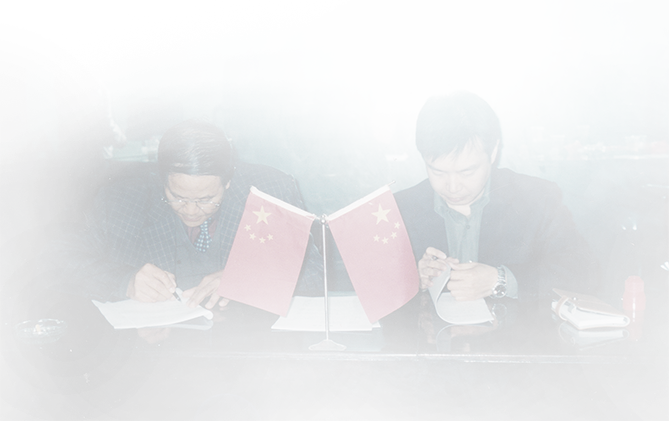
A historic signing moment from the 1970s, when HG’s founder helped drive the development of China’s food industry and began expanding into international markets.
Over the past decades, we have participated in the evolution of automated food production — from local factories to global turnkey projects across 100+ countries. That experience continues to shape every HG production line today.
Discover Our Heritage
Global Food Machinery &
Turnkey Factory Solutions

Building Long-Term Partnerships Through Shared Growth and Industrial Value.
Copyright © HG Industry Group All Rights Reserved
Food Machine Snack Food Processing Machinery

Unauthorized use of this website's content constitutes copyright infringement and may result in legal action.