 English
 中文简体
中文简体 日本語
日本語 русский
 عربى
عربى Український
 Español
 Français


How a Donut Production Line Bakes Perfect Donuts, From Dough to Package
Content
- 1. What Exactly Is a Baked Donut Production Line?
- 2. The Baking Process, Step by Step
- 3. Baking Equipment & Technology Explained
- 4. Types of Donut Production Lines by Scale
- 5. Output Capacity and Typical Costs
- 6. Key Baking Equipment to Evaluate Before Buying
- 7. Maintenance Practices That Keep the Baking Line Running
- 8. Questions to Ask a Donut Production Line Supplier About Baking Technology
Donuts look simple on a shelf, but getting thousands of identical, evenly baked rings out of a factory every hour is a serious engineering problem. A modern donut production line solves that problem by turning dough mixing, depositing, proofing, baking, cooling, filling, glazing, and packaging into one continuous, automated flow. This guide breaks down how a baked donut line actually works, what equipment goes into it, and what to look for if you're planning to buy one.
1. What Exactly Is a Baked Donut Production Line?
A baked donut production line is a connected series of machines that turns raw dough into finished, packaged donuts without manual handling at each stage. Unlike fried donut lines, which cook product in hot oil, baked lines use tunnel ovens or convection ovens to set the crumb structure, giving a lighter texture and a lower-fat finished product.
At its core, the line performs five functions in sequence:
- Mixing and dough preparation – combining flour, sugar, fat, yeast or chemical leavening, and liquids into a consistent dough or batter
- Depositing and shaping – forming the dough into rings, holes, or specialty shapes
- Proofing – allowing yeast-raised dough to rise under controlled humidity and temperature
- Baking – cooking the product through a tunnel or oven system
- Finishing – cooling, filling, glazing, sugaring, and packaging
Because these stages are linked by conveyors and controlled by a central system, a baked donut line can run continuously for hours with minimal operator intervention, which is what separates it from a bakery producing donuts in small batches.
2. The Baking Process, Step by Step
Step 1: Mixing. Ingredients are combined in a spiral or planetary mixer under controlled time and speed to develop the right gluten structure without overworking the dough.
Step 2: Depositing or extrusion. A rotary depositor or extruder cuts and shapes the dough into rings on a conveyor belt or directly into baking trays, keeping portion weight and shape consistent across every piece.
Step 3: Proofing. Shaped dough moves into a proofing cabinet where temperature (typically around 35–40°C) and humidity are held steady so the yeast can raise the dough evenly before baking.
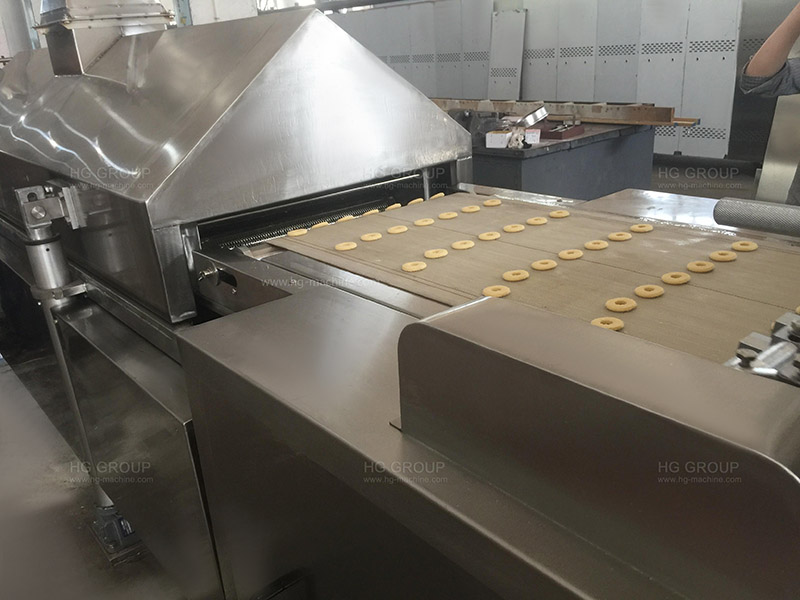
Step 4: Baking. The proofed dough passes through a tunnel oven with multiple heat zones. Zone-by-zone temperature control lets the line brown the surface, set the crumb, and avoid collapsing the donut's structure.
Step 5: Cooling. Baked donuts pass through a spiral or linear cooling tunnel that brings the product down to a safe temperature before any topping is applied, preventing glaze from melting off or filling from leaking.
Step 6: Filling, glazing, and topping. Depending on the product, donuts may be injected with cream or fruit filling, dipped or enrobed in glaze or chocolate, and dusted with sugar, sprinkles, or nuts.
Step 7: Packaging. Finished donuts are counted, arranged, and sealed by automatic packaging equipment, often with modified atmosphere packaging to extend shelf life.
3. Baking Equipment & Technology Explained
The oven is the heart of the line, and there are a few common technologies:
- Tunnel ovens move product on a mesh or plate conveyor through sequential heat zones, offering the highest throughput and the most even baking for continuous lines.
- Convection ovens circulate hot air around the product, useful for smaller or mid-size operations that need more flexibility between product types.
- Impingement ovens direct high-velocity jets of hot air onto the product surface, cutting bake time and improving crust color, though they need careful calibration to avoid drying the product out.
Beyond the oven, key technology includes PLC-based control systems that synchronize conveyor speed with oven zone temperatures, humidity sensors in proofing cabinets, and increasingly, vision systems that check shape and color consistency before packaging.
4. Types of Donut Production Lines by Scale
- Small/artisan lines — semi-automatic, often a standalone mixer, manual or semi-auto depositor, and a compact oven; suited to bakeries and small retail operations producing a few hundred to a couple thousand units per day.
- Mid-scale lines — fully connected conveyor systems with automatic depositing, proofing, and baking, aimed at regional bakeries or food service suppliers producing several thousand to tens of thousands of units daily.
- Industrial/large-scale lines — fully automated from mixing to packaging, with multiple parallel oven lanes, robotic topping stations, and integrated packaging, built for national or export-scale manufacturers producing well over 50,000 units per day.
The right scale depends less on ambition and more on realistic demand forecasts, since oversized equipment sitting idle is one of the most common costly mistakes buyers make.
5. Output Capacity and Typical Costs
Output and cost vary widely with automation level and oven size:
- Small lines: roughly 500–3,000 pieces/hour; equipment cost typically in the tens of thousands of dollars range.
- Mid-scale lines: roughly 3,000–10,000 pieces/hour; typically a mid-six-figure investment depending on how many finishing stations (filling, glazing) are included.
- Large industrial lines: 10,000+ pieces/hour, sometimes well over 20,000; investment can run into seven figures once packaging, filling, and multiple oven lanes are integrated.
These figures are directional rather than fixed quotes — actual pricing depends heavily on the supplier, automation level, region, and whether the line is custom-built or a modular standard configuration. Always request a formal quote based on your specific throughput and product mix rather than budgeting off general industry figures.
6. Key Baking Equipment to Evaluate Before Buying
When comparing suppliers, focus on:
- Oven zone count and control precision — more independently controlled zones mean better ability to fine-tune bake profiles for different product types
- Conveyor belt material and width — affects both durability and how easily the line can be reconfigured for new products
- Proofer humidity and temperature stability — inconsistent proofing is one of the biggest causes of uneven donuts
- Changeover time — how quickly the line can switch between donut shapes, sizes, or recipes
- Energy source and efficiency — gas, electric, or hybrid heating affects both running costs and installation requirements
- Sanitation design — easy-to-clean surfaces and accessible components matter enormously for food safety compliance and downtime reduction
- Integration compatibility — whether the oven and finishing equipment can be matched with your existing mixer, packaging line, or plant layout
7. Maintenance Practices That Keep the Baking Line Running
- Daily cleaning of depositors, conveyors, and contact surfaces to prevent dough buildup and bacterial growth
- Scheduled oven calibration to catch temperature drift before it affects product quality
- Belt tension and alignment checks to prevent conveyor wander, which can misalign product through the oven
- Preventive lubrication of moving parts per the manufacturer's schedule, rather than waiting for audible wear
- Sensor and control system audits to make sure humidity, temperature, and timing sensors are reading accurately
- Spare parts stocking for high-wear components like belts, nozzles, and heating elements to minimize unplanned downtime
A well-maintained line typically sees far fewer quality rejects and unplanned stoppages, which matters more to overall output than almost any single piece of equipment spec.
8. Questions to Ask a Donut Production Line Supplier About Baking Technology
- What is the actual, tested output rate for our specific donut size and recipe — not just the rated maximum?
- How many independently controlled heat zones does the oven have, and how is temperature uniformity verified?
- What is the expected changeover time between different donut shapes or sizes?
- What energy source does the oven use, and what are the estimated running costs at our target volume?
- What automation level is included as standard, and what would upgrading later cost?
- What is the warranty period, and what does routine maintenance support look like after installation?
- Can the supplier provide references or case studies from bakeries producing a similar product mix and volume?
- How is food safety and sanitation addressed in the equipment design (materials, accessibility, cleaning protocols)?
- What is the lead time for delivery and installation, and does the supplier provide operator training?
- Is the line modular enough to add filling, glazing, or packaging stations later without a full rebuild?
Asking these questions up front helps separate suppliers who understand baking technology from those simply selling steel and conveyor belts — and it's the difference between a line that scales with your business and one you outgrow in two years.
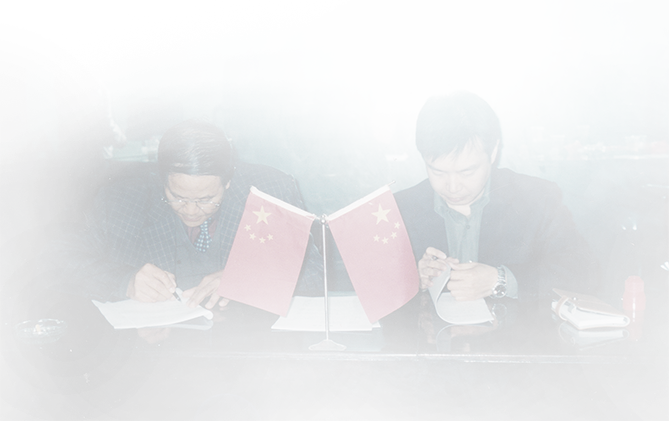
A historic signing moment from the 1970s, when HG’s founder helped drive the development of China’s food industry and began expanding into international markets.
Over the past decades, we have participated in the evolution of automated food production — from local factories to global turnkey projects across 100+ countries. That experience continues to shape every HG production line today.
Discover Our Heritage
Global Food Machinery &
Turnkey Factory Solutions

Building Long-Term Partnerships Through Shared Growth and Industrial Value.
Copyright © HG Industry Group All Rights Reserved
Food Machine Snack Food Processing Machinery

Unauthorized use of this website's content constitutes copyright infringement and may result in legal action.