 English
 中文简体
中文简体 日本語
日本語 русский
 عربى
عربى Український
 Español
 Français
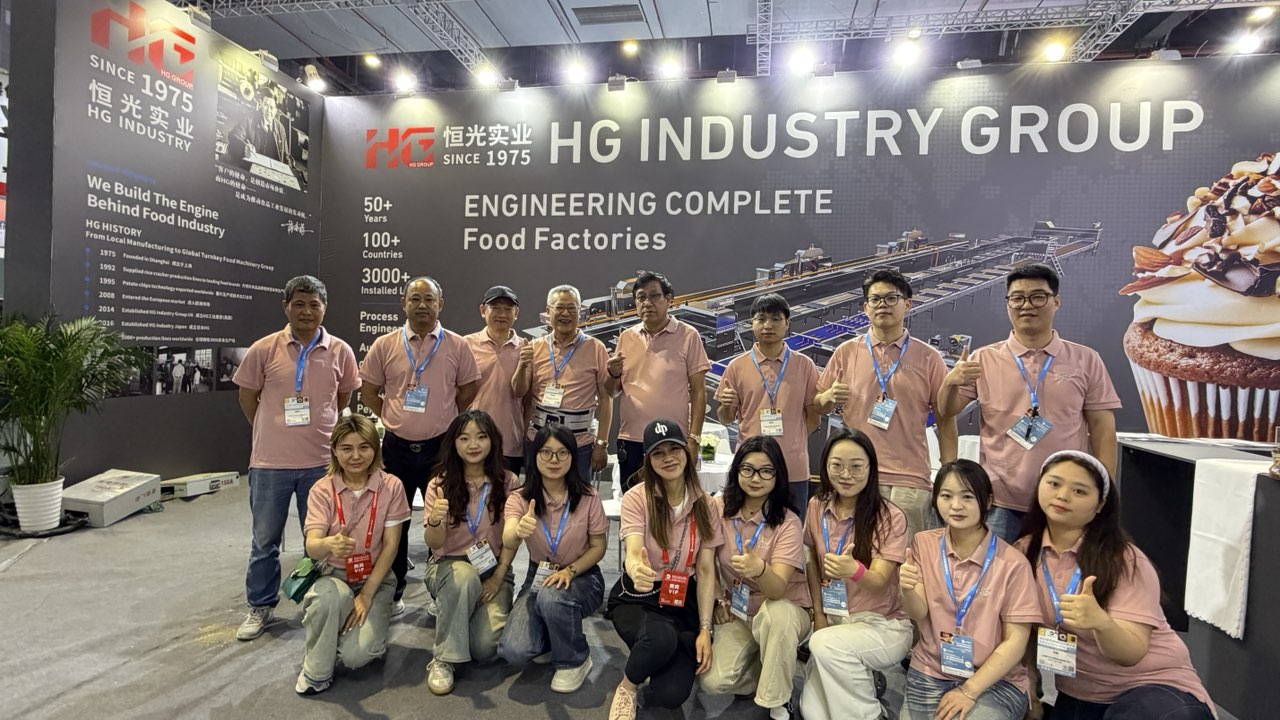


Automatic Filled Biscuit Production Line: How Automated Systems Deliver Consistent Filling and Perfect Sandwich Biscuits Every Time
Content
- 1. Why Manufacturers Switch to an Automatic Filled Biscuit Production Line
- 2. How the Filling and Sandwiching Process Works on an Automated Line
- 3. What a Full Filled Biscuit Line Includes — Core Machine Configurations
- 4. Matching Line Configuration to Your Biscuit and Filling Types
- 5. Common Problems on a Filled Biscuit Line and How to Fix Them
- 6. Hygiene and Food Safety Standards on Automated Biscuit Lines
- 7. Calculating Return on Investment Before You Buy
1. Why Manufacturers Switch to an Automatic Filled Biscuit Production Line
Sandwich and filled biscuits look simple on a supermarket shelf, but producing them consistently at scale is one of the harder challenges in biscuit manufacturing. Two biscuit layers have to be baked to matching color and texture, a precise amount of cream, jam, chocolate, or fruit filling has to be deposited without overflow, and the two halves need to be pressed together cleanly so nothing leaks out during packaging or transport.
Manual or semi-automatic filling quickly becomes a bottleneck as order volumes grow. Cream weight varies from worker to worker, sandwiching pressure isn't uniform, and output rarely exceeds what a small line of operators can hand-align. An automatic filled biscuit production line solves these problems by linking baking, cooling, filling, and sandwiching into one continuous, sensor-controlled process — cutting labor costs, reducing filling waste, and giving every pack the same weight and appearance batch after batch.
For manufacturers scaling from a regional brand to national or export volumes, automation isn't just about speed. It's about meeting the consistency that retailers and export markets demand, while keeping filling costs under control since cream and filling materials are often the most expensive ingredient in the product.
2. How the Filling and Sandwiching Process Works on an Automated Line
On a fully automated line, biscuits move from the oven through cooling in a continuous stream, arriving at the filling section already stable enough to handle pressure without cracking. From there, the process typically runs as follows:
- Biscuit orientation and pairing — biscuits are aligned into rows, with matching pairs selected so top and bottom biscuits are consistent in size and shape.
- Filling deposit — a metering pump or gear-driven depositor lays a precise amount of cream, chocolate, or jam onto the bottom biscuit. Volume is controlled electronically, so a change in recipe or biscuit size can be adjusted from a control panel rather than by hand.
- Sandwiching — the top biscuit is placed and pressed with calibrated, even pressure so the filling spreads evenly to the edges without oozing out.
- Cooling/setting tunnel — for cream fillings that need to firm up, sandwiched biscuits pass through a short cooling tunnel before packaging to lock the filling in place and prevent shifting.
- Inspection and rejection — sensors or vision systems can flag biscuits with insufficient filling, misalignment, or breakage, automatically diverting them before packaging.
The entire sequence is timed to match oven output, so the filling section neither starves for biscuits nor creates a backlog — a balance that's tuned during commissioning and adjusted as recipes change.
3. What a Full Filled Biscuit Line Includes — Core Machine Configurations
A complete automatic filled biscuit production line is built from several linked machine sections, each with its own role:
- Mixer and dough forming section — mixes dough and forms it via rotary molding or wire-cut extrusion depending on biscuit type.
- Tunnel oven — multi-zone baking to control color and moisture consistently across the width of the band.
- Cooling conveyor — brings biscuits down to a stable temperature before handling.
- Filling and sandwiching machine — the core of the line, handling deposit volume, pairing, and pressing as described above.
- Cooling/setting tunnel (for cream-filled products) — stabilizes the filling before packaging.
- Packaging feed system — aligns finished biscuits for flow-wrap or tray packaging machines downstream.
Some manufacturers also add a enrobing or coating section if part of the range includes chocolate-coated sandwich biscuits, and a stacking unit for products packed in rolls or trays rather than individually wrapped.
Because these sections are modular, a line can be configured for straightforward two-biscuit sandwiches or expanded to handle triple-layer biscuits, multiple filling flavors on rotation, or co-extruded fillings for more complex products.
4. Matching Line Configuration to Your Biscuit and Filling Types
Not every filled biscuit line needs the same configuration, and matching it to your product range avoids paying for capability you won't use — or under-speccing equipment that can't handle your actual filling viscosity.
Key factors to consider:
- Filling viscosity — thin creams and thick pastes behave differently in metering pumps; gear pumps handle viscous fillings better, while piston depositors suit thinner creams and jams.
- Biscuit fragility — delicate wafer-type biscuits need gentler pressing force and softer handling through conveyors than denser, sturdier cookie bases.
- Filling temperature sensitivity — chocolate-based fillings may need a temperature-controlled hopper and jacketed piping to stay workable without seizing or separating.
- Product variety — if you run multiple SKUs (different biscuit sizes, filling flavors, or single vs. double filling layers), look for lines with quick-changeover tooling and recipe-programmable filling volumes rather than mechanical adjustments that require a technician each time.
- Output target — line speed (biscuits per minute) should be matched to your oven capacity; an over-specced filling machine sitting idle wastes capital, while an under-specced one becomes the new bottleneck.
Working through these specifics with your equipment supplier before finalizing an order — ideally with sample runs of your actual filling and dough — prevents costly reconfiguration after installation.
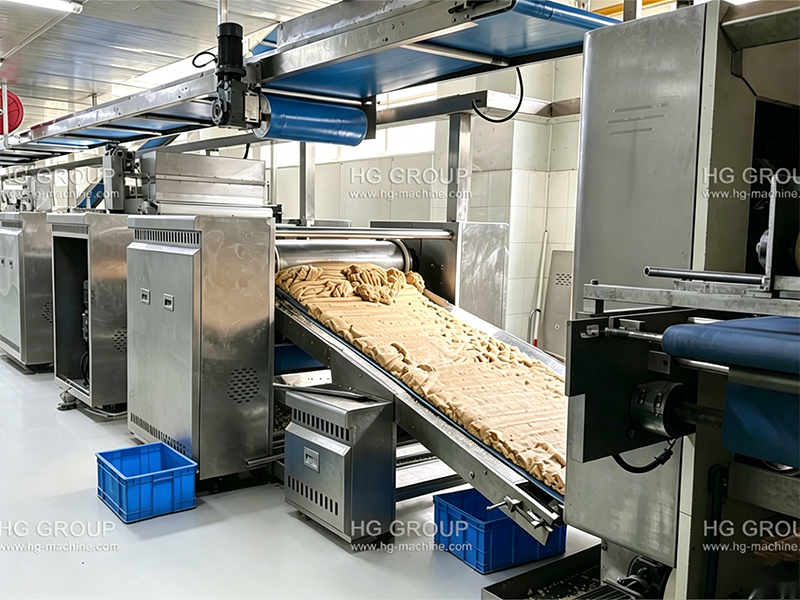
5. Common Problems on a Filled Biscuit Line and How to Fix Them
Even well-designed lines run into recurring issues. Knowing the common causes speeds up troubleshooting:
- Filling overflow or leakage at the edges — usually caused by excess filling volume, misaligned biscuit pairing, or pressing force that's too high. Recalibrating the depositor volume and checking alignment sensors typically resolves this.
- Inconsistent filling weight — often a sign of air pockets in the filling hopper, pump wear, or filling that has separated (common with oil-based fillings that need periodic remixing). Regular pump maintenance and a properly agitated hopper prevent drift over a shift.
- Biscuit breakage during sandwiching — pressure set too high for a fragile biscuit, or biscuits entering the filling section before they've cooled and hardened enough. Extending cooling time or lowering press force usually fixes it.
- Filling not centered on the biscuit — conveyor speed mismatched with depositor timing, or wear in the guide rails causing biscuits to drift off-center. Timing and rail alignment checks should be part of routine maintenance.
- Cream not setting before packaging — cooling tunnel too short or set too warm for the filling's melting point, leading to smeared or shifted filling in the pack. Adjusting tunnel dwell time and temperature to match the specific filling recipe addresses this.
Most of these issues point back to a small set of root causes — pump condition, temperature control, and mechanical alignment — so a maintenance routine that checks these three areas regularly prevents the majority of downtime.
6. Hygiene and Food Safety Standards on Automated Biscuit Lines
Because filled biscuits combine baked product with a filling added after baking — often without further heat treatment — hygiene control at the filling stage is critical. Contamination introduced here doesn't get "cooked out" the way it might upstream.
Standards to look for in line design and operation include:
- Food-grade stainless steel construction on all filling-contact surfaces (hoppers, pumps, nozzles, piping), with smooth welds and no dead spots where residue can collect.
- CIP (clean-in-place) or easily disassembled filling systems, so hoppers and pumps can be cleaned thoroughly between filling flavor changes without lengthy manual teardown.
- Enclosed or shielded conveyor sections in the filling area to limit airborne contamination and pest access.
- Temperature-controlled filling storage to prevent bacterial growth in dairy-based or perishable fillings while they sit in the hopper.
- Compliance documentation — lines intended for export markets should be built to meet standards such as HACCP, ISO 22000, or destination-market-specific food safety certifications, with traceability for filling batches.
Hygiene isn't a one-time design feature — it depends on operators following changeover and cleaning procedures consistently, so training staff on CIP cycles and flavor-changeover protocols is as important as the equipment specification itself.
7. Calculating Return on Investment Before You Buy
An automatic filled biscuit production line is a significant capital investment, and the payback period depends on more than just the machine's price tag. A realistic ROI calculation should account for:
- Labor savings — compare current headcount for manual filling/sandwiching against the reduced crew needed to operate and monitor an automated line.
- Filling material savings — precise metering typically reduces filling overuse by a measurable percentage compared to manual application, which adds up quickly since filling is often the costliest ingredient by weight.
- Reduced rejects and rework — fewer broken, misaligned, or under-filled biscuits means less product written off as waste.
- Increased output capacity — higher throughput can mean either meeting existing demand with fewer shifts, or taking on new orders without adding a second manual line.
- Maintenance and spare parts costs — factor in routine servicing, pump wear parts, and technician availability, which vary by equipment brand and local support access.
- Changeover flexibility value — if your product range grows, a line with quick recipe/flavor changeover avoids future capital spend on a second dedicated line.
Most manufacturers find payback periods ranging from roughly 18 months to 3 years depending on production volume and prior labor costs — but the calculation is specific to your product mix, so it's worth requesting a capacity and cost breakdown from your equipment supplier based on your actual filling formulation and target output, rather than relying on generic industry averages.
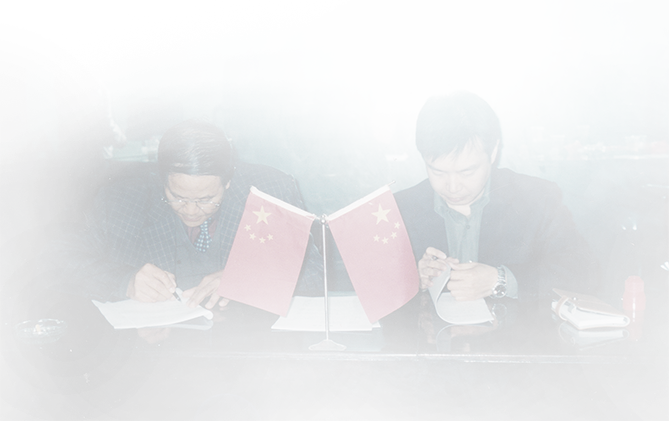
A historic signing moment from the 1970s, when HG’s founder helped drive the development of China’s food industry and began expanding into international markets.
Over the past decades, we have participated in the evolution of automated food production — from local factories to global turnkey projects across 100+ countries. That experience continues to shape every HG production line today.
Discover Our Heritage
Global Food Machinery &
Turnkey Factory Solutions

Building Long-Term Partnerships Through Shared Growth and Industrial Value.
Copyright © HG Industry Group All Rights Reserved
Food Machine Snack Food Processing Machinery

Unauthorized use of this website's content constitutes copyright infringement and may result in legal action.