 English
 中文简体
中文简体 日本語
日本語 русский
 عربى
عربى Український
 Español
 Français


A Practical Guide to Choosing the Right Biscuit Production Line
Content
- What Is a Biscuit Production Line and Who Uses One
- How the Line Turns Dough Into Finished Biscuits
- Key Components Worth Comparing Before You Buy
- Comparing Output Capacity Across Different Line Scales
- Maintenance Practices That Reduce Downtime
- Questions to Ask Before Selecting a Supplier
- Real-World Performance: A Look at How These Lines Hold Up Overseas
- Choosing Equipment That Fits Your Production Goals
What Is a Biscuit Production Line and Who Uses One
A biscuit production line is a connected set of equipment that turns raw ingredients into finished, packaged biscuits with minimal manual intervention. Instead of mixing dough, shaping, baking, and packing as separate manual tasks, an automatic biscuit production line handles each stage in sequence — dough mixing, forming, baking, cooling, and often packaging — all synchronized through a single conveyor system. This kind of setup is commonly used by commercial bakeries, snack food manufacturers, contract producers making private-label biscuits, and exporters supplying retail chains. Businesses typically move toward this kind of biscuit manufacturing equipment once order volumes outpace what manual or semi-manual production can reliably handle, especially when consistency and food safety compliance become harder to maintain at scale.
How the Line Turns Dough Into Finished Biscuits
A biscuit production line typically runs through several connected stages, each affecting the final texture, shape, and quality of the product. Knowing how these stages work helps buyers figure out which parts of the line deserve the most scrutiny during equipment selection.
Dough Mixing and Preparation
Dough is prepared in mixing units that combine flour, fat, sugar, and other ingredients to a consistent texture suitable for the forming method being used. Hard dough biscuits and soft dough biscuits require different mixing approaches, since gluten development needs to be controlled differently depending on whether the final product needs to be crisp and dense or light and crumbly.
Forming and Shaping
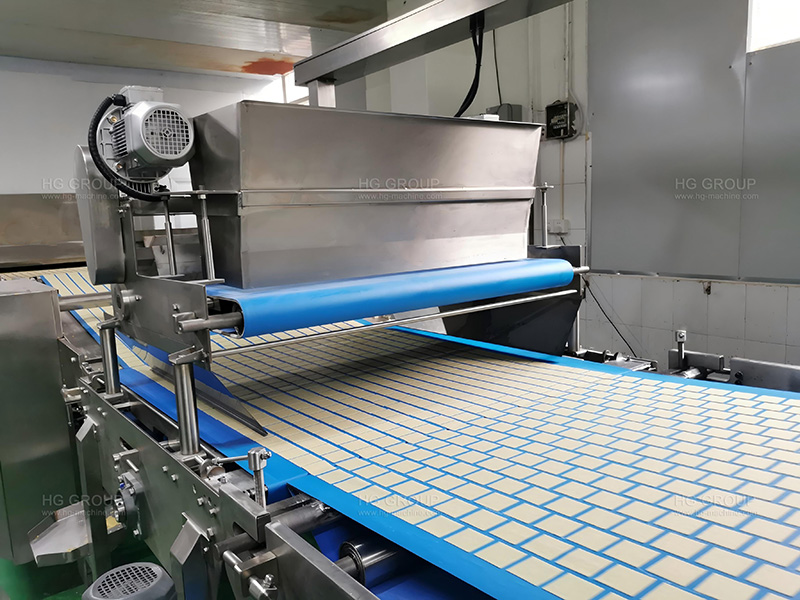
After mixing, dough moves to a forming machine, which shapes biscuits using either rotary molding or wire-cut methods, depending on the product type. Rotary molding presses dough into engraved molds for detailed shapes and surface patterns, while wire-cut forming extrudes dough through a die and slices it into pieces — a method commonly used for drop-style or chunk-filled biscuits.
Baking and Oven Zoning
Shaped biscuits pass through a multi-zone tunnel oven, where different sections control temperature and airflow independently to manage browning, moisture loss, and texture development. Getting this zoning right is one of the more technical aspects of an industrial biscuit line, since uneven baking is one of the most common quality complaints buyers run into with poorly calibrated equipment.
Cooling, Sandwiching, and Packaging
After baking, biscuits travel through a cooling conveyor to stabilize texture before moving to optional secondary processes such as cream sandwiching or chocolate coating. From there, finished biscuits are typically fed directly into packaging equipment, allowing the entire process from raw dough to sealed package to run as one continuous operation.
Key Components Worth Comparing Before You Buy
Equipment quality varies significantly between suppliers, and the differences often show up in long-term reliability rather than in initial product samples. Buyers evaluating a biscuit making machine setup should pay close attention to the following components.
- Forming method compatibility — confirm whether the line supports rotary molding, wire-cut, or both, depending on product variety
- Oven zone control — more independently controlled zones generally allow finer-tuned baking profiles
- Mold and die quality — engraving precision and wear resistance affect product detail and replacement frequency
- Dough mixer capacity — should be matched to the forming machine's throughput to avoid bottlenecks
- Control system — PLC-based systems with recipe storage simplify changeovers between biscuit types
- Sanitary design — easy-to-clean surfaces and accessible inspection points reduce downtime between production runs
Comparing Output Capacity Across Different Line Scales
Matching production capacity to actual demand is one of the most important decisions buyers make when investing in a biscuit production line. The table below outlines general output ranges across different scales of equipment to help with initial planning.
|
Line Type |
Typical Output |
Best Suited For |
|
Small Semi-Automatic Line |
100–300 kg/hour |
Small bakeries, startup brands testing new products |
|
Mid-Size Automatic Line |
500–1,000 kg/hour |
Regional manufacturers, contract production facilities |
|
Full Industrial Line |
1,500+ kg/hour |
Large-scale producers supplying retail or export markets |
Maintenance Practices That Reduce Downtime
Consistent maintenance keeps a biscuit production line running at full efficiency and prevents small issues from turning into costly breakdowns. Operators who follow a structured maintenance schedule tend to experience fewer unplanned stoppages and more stable product quality over time.
- Clean forming molds and dies regularly to prevent dough buildup from distorting biscuit shape
- Check oven burner or heating element performance periodically to catch temperature drift early
- Inspect conveyor belts for wear and tension, since misalignment can affect baking uniformity
- Lubricate mechanical components such as cutting blades and chain drives on a fixed schedule
- Maintain a stock of critical spare parts, including molds, blades, and sensors, to minimize repair delays
Questions to Ask Before Selecting a Supplier
Since a biscuit production line is a major investment, it's worth pressing suppliers for specific, verifiable details rather than relying on general sales claims. How clearly and thoroughly a supplier answers these questions often reflects how reliable they'll be after the sale.
- What is the verified output rate under actual production conditions, not just the rated maximum?
- Can the line handle multiple biscuit types, such as both hard dough and soft dough products?
- What food-safety certifications apply to the equipment's contact materials?
- How long does a typical product changeover take between different biscuit shapes or recipes?
- What warranty coverage and after-sales support are included with the purchase?
- Does the supplier offer on-site installation and operator training, or only remote assistance?
Real-World Performance: A Look at How These Lines Hold Up Overseas
Specifications on paper only tell part of the story — how a line performs after it leaves the factory and runs day after day in a real production facility is what actually matters to a buyer. This is where looking at equipment already operating in the field can be more informative than any spec sheet.
One example worth noting is HG's biscuit production lines, which have been installed and running in Algeria for several years. In 2019, this equipment drew the attention of local Algerian TV stations, which featured HG's line in multiple special reports. The footage showed the full process running end to end — from raw material mixing through biscuit forming and baking — with the automated sequence and process control holding up consistently under everyday production conditions, giving local audiences a close-up look at how the equipment actually performs rather than just how it's marketed.
Cases like this are a useful reference point for buyers researching biscuit manufacturing equipment from Chinese suppliers, since HG's lines have since been installed across a number of countries and regions beyond Algeria. The coverage in Algeria is less a one-off story and more a snapshot of a broader track record: equipment that's been put to work internationally and continues to run reliably under real operating conditions, rather than only performing well in a controlled demo setting.
For buyers going through supplier evaluation, this kind of on-the-ground history is worth asking about directly — request references from existing overseas installations, and where possible, ask whether any independent coverage or third-party documentation of the equipment's actual performance exists, rather than relying solely on the supplier's own promotional materials.
Choosing Equipment That Fits Your Production Goals
Selecting the right biscuit production line comes down to matching equipment capability with your actual product range, volume needs, and quality standards, rather than simply choosing the line with the most impressive specifications. Buyers who carefully compare forming methods, oven control, and supplier reliability tend to avoid the operational issues that come from rushed equipment decisions. Whether you're scaling up from manual production or expanding an existing facility, a clear understanding of how the line works and what to verify before purchasing will help you choose equipment that genuinely supports your production goals.
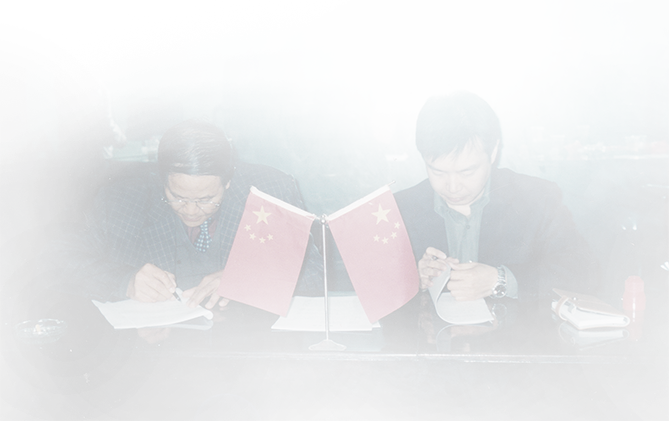
A historic signing moment from the 1970s, when HG’s founder helped drive the development of China’s food industry and began expanding into international markets.
Over the past decades, we have participated in the evolution of automated food production — from local factories to global turnkey projects across 100+ countries. That experience continues to shape every HG production line today.
Discover Our Heritage
Global Food Machinery &
Turnkey Factory Solutions

Building Long-Term Partnerships Through Shared Growth and Industrial Value.
Copyright © HG Industry Group All Rights Reserved
Food Machine Snack Food Processing Machinery

Unauthorized use of this website's content constitutes copyright infringement and may result in legal action.