 English
 中文简体
中文简体 日本語
日本語 русский
 عربى
عربى Український
 Español
 Français


HG Wafer Roll & Egg Roll Technology Heritage: From Early Production Systems to Integrated Line Engineering
Content
- From Early Equipment to Production-Line Engineering
- Engineering Evolution, Not Simply Machine Upgrading
- Why Production-Line Engineering Matters
- From Historical Egg Roll Equipment to Multi-Head Systems
- The Development of HG's 4-Head Technology
- What Has Changed — and What Has Not
- From Historical Technology to Today's Integrated Production Lines
- How HG Engineers an Egg Roll or Wafer Roll Production Line Today
- A Technology Heritage Built Around Real Production
- Related HG Wafer Roll & Egg Roll Engineering Topics
How HG's Egg Roll Technology Evolved from Early Equipment Development to Modern Production-Line Engineering
Egg roll and wafer roll production is not simply about producing a finished rolled product.
At industrial scale, stable production requires multiple processes to work together, including batter preparation, forming, baking, rolling, filling, cutting, cooling, conveying and downstream handling.
HG's technology development in this field can be traced back to the early 2000s, with documented patent evidence related to filled egg roll production line equipment.
This early development provides an important part of HG's technology heritage and helps explain how HG's approach has evolved from individual equipment to integrated production-line engineering.
2004: Patent Evidence for an Integrated Filled Egg Roll Production System
One of the key historical records in HG's egg roll technology development is a utility model patent related to filled egg roll production line equipment.
The patent was filed in November 2004 by Shanghai Fengxian Food & Beverage Complete Equipment Factory and was later published as CN2774159Y.
Patent Information
Patent No.: CN2774159Y
Patent Title: Equipment for Filled Egg Roll Production Line
Filing Date: November 18, 2004
Publication Date: April 26, 2006
Original Assignee: Shanghai Fengxian Food & Beverage Complete Equipment Factory
The patent describes a connected production arrangement involving multiple processing units, including:
Batter Mixing → Batter Storage → Batter Pumping → Forming & Baking → Rolling → Filling → Cutting
The patent documentation describes these units as sequentially connected to form a filled egg roll production line.
This is significant because the documented system was already focused on connecting multiple production stages into one coordinated line, rather than treating egg roll equipment as a standalone machine.
View CN2774159Y Patent Record
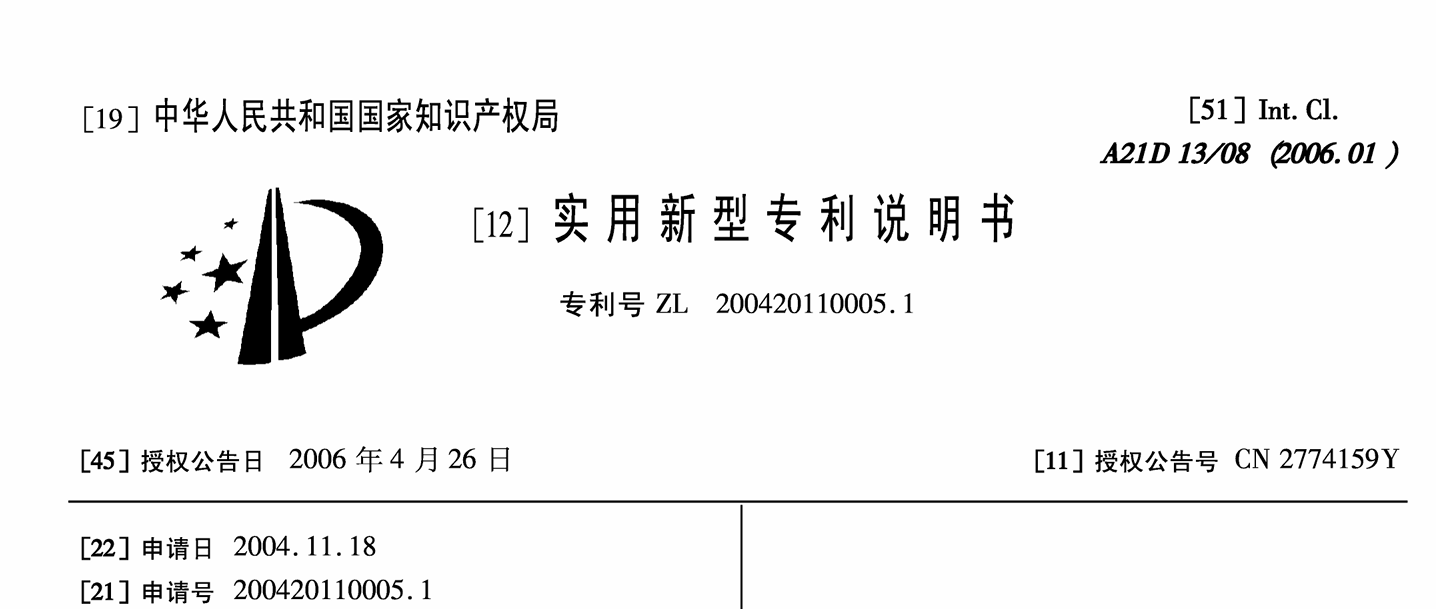
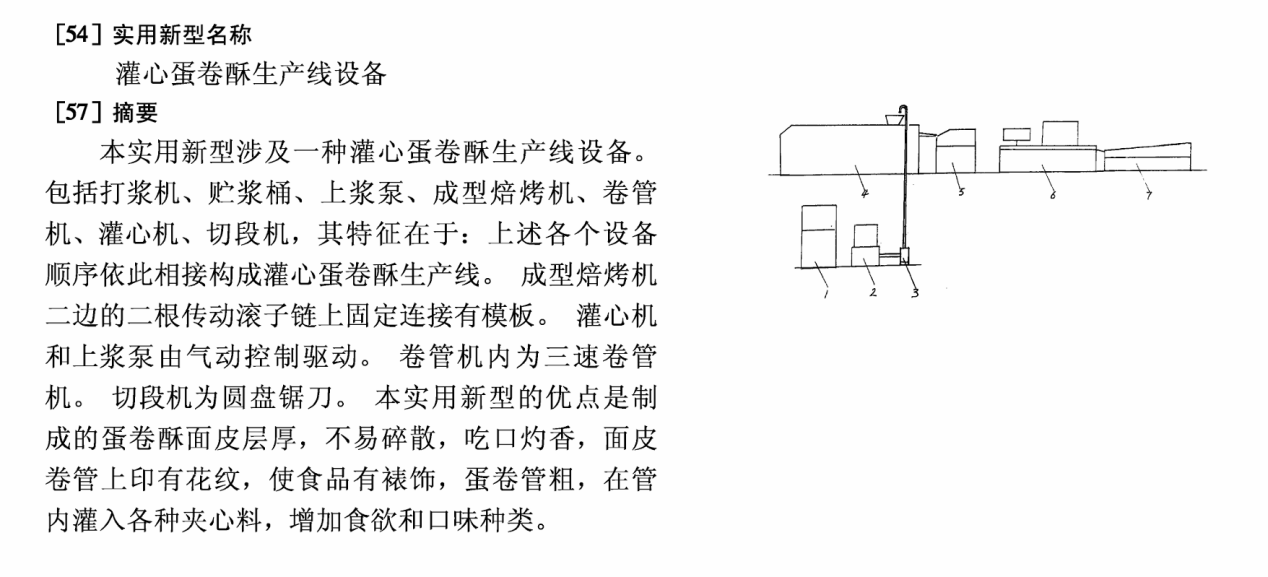
Patent evidence: CN2774159Y — Equipment for Filled Egg Roll Production Line.
Only a limited section of the original patent documentation is displayed publicly. The complete technical document is retained as an internal reference.
From Early Equipment to Production-Line Engineering
The requirements of egg roll and wafer roll manufacturers have changed significantly over time.
Early industrial equipment focused on continuous forming, baking and rolling.
As production volumes increased, however, customers needed more than an individual machine.
They needed different production stages to work together as one system.
This changed the engineering question from:
How fast can one machine run?
to:
How should the complete production system be configured to achieve stable and accepted output?
This principle remains important in modern wafer roll and egg roll production-line engineering.
Early HG Egg Roll Production Equipment
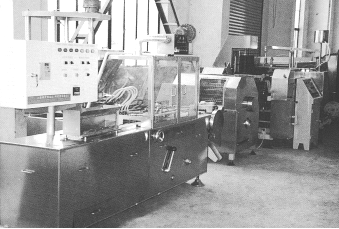
Archival HG egg roll production equipment from the early stage of the company's egg roll technology development.
The historical equipment shown above represents an earlier stage of HG's equipment development.
It should not be considered the same technology as today's production systems. Instead, it provides physical evidence of the equipment-development stage that preceded HG's current integrated production-line approach.
Engineering Evolution, Not Simply Machine Upgrading
HG's development of egg roll and wafer roll production technology can be understood through several stages:
1. Early Equipment Development
Early systems established the basic industrial equipment required for continuous egg roll production.
2. Integrated Process Development
Production systems increasingly connected batter preparation, forming, baking, rolling, filling and cutting into coordinated production processes.
3. Higher-Capacity Equipment
As customer production requirements increased, equipment configurations developed toward higher-capacity and multi-head systems.
4. Modern Production-Line Engineering
Today's production projects require coordination between:
- Production capacity
- Process stability
- Automation
- Conveying
- Cooling
- Arranging
- Product transfer
- Downstream packaging
The objective is therefore not simply to make one machine faster.
It is to configure the entire production line so that each stage can operate together under the customer's actual production conditions.
Why Production-Line Engineering Matters
A wafer roll or egg roll production line contains multiple processes with different operating requirements.
Increasing the output of one section does not necessarily increase the final production output if another section becomes the bottleneck.
For example:
- Baking capacity may become a bottleneck.
- Rolling may not keep up with forming.
- Filling capacity may be insufficient.
- Cutting may restrict product flow.
- Cooling time may limit throughput.
- Conveying or arranging may become unstable.
- Packaging capacity may be lower than upstream production.
Therefore, HG evaluates capacity at the production-system level.
The objective is not simply to quote the highest possible machine speed.
The objective is to configure a production line in which the major processes can operate together under the customer's product specifications, factory conditions and target capacity.
From Historical Egg Roll Equipment to Multi-Head Systems
As production demand increased, higher-capacity configurations became increasingly important.
Multi-head systems provide a way to increase production capacity while maintaining coordinated processing across multiple production units.
However, adding production heads also creates additional engineering requirements.
A complete system needs to consider:
- Product consistency
- Batter distribution
- Baking stability
- Rolling synchronization
- Filling accuracy
- Cutting
- Product transfer
- Cooling
- Downstream capacity
Therefore, HG's approach to higher-capacity equipment is based on system coordination, rather than simply adding more production heads.
The Development of HG's 4-Head Technology
The current 4-head wafer roll and egg roll system represents another stage in this technology development.
Compared with earlier equipment concepts, higher-capacity multi-head systems require greater coordination between individual production units and downstream processes.
For suitable products and production conditions, a 4-head configuration can increase production capacity while making more efficient use of factory space and supporting continuous production.
However, actual accepted output still depends on the complete production system.
HG therefore evaluates:
Machine Configuration + Product Specification + Process Conditions + Downstream Capacity
rather than using the number of production heads alone as the definition of capacity.
What Has Changed — and What Has Not
Equipment has changed considerably since the early 2000s.
Today's production lines can incorporate higher levels of automation, more advanced control systems, higher-capacity configurations, cooling systems, conveying and downstream production connections.
But one engineering principle remains:
Each production stage must work together as part of one complete system.
This principle can already be seen in the documented CN2774159Y filled egg roll production equipment, where multiple processing units were designed to operate sequentially as a production line.
Today's integrated systems extend this concept through higher capacity, automation, conveying, cooling, arranging and downstream production connections.
From Historical Technology to Today's Integrated Production Lines
HG's wafer roll and egg roll technology heritage can therefore be viewed as a continuous engineering development:
Early 2000s Egg Roll Equipment
↓
2004 Patent Filing — CN2774159Y
↓
Integrated Production Processes
↓
Multi-Head Equipment Development
↓
4-Head High-Capacity Systems
↓
Modern Integrated Production-Line Engineering
The historical equipment is not presented as today's technology.
Instead, it provides documented evidence of an earlier stage in HG's engineering development.
The value of this history is that it helps explain why HG approaches today's wafer roll and egg roll projects from a production-line engineering perspective.
How HG Engineers an Egg Roll or Wafer Roll Production Line Today
For a new project, HG does not start with a machine model alone.
The engineering process begins with the customer's production requirements.
1. Product Definition
HG evaluates:
- Egg roll or wafer roll type
- Product dimensions
- Filling requirements
- Product weight
- Surface and texture requirements
- Packaging format
2. Capacity Planning
The target production capacity is evaluated against:
- Product specification
- Machine configuration
- Production speed
- Process stability
- Downstream capacity
3. Process Configuration
The production sequence is established according to the product and factory requirements.
4. Equipment Matching
Each production stage is configured to work with the preceding and following processes.
5. Line Integration
Conveying, cooling, arranging and downstream equipment are considered as part of the complete production system.
6. Production Validation
Before delivery, the equipment configuration and production requirements are checked against the agreed project specifications.
This is where historical equipment experience becomes relevant to modern industrial projects.
A Technology Heritage Built Around Real Production
The history of HG's egg roll technology is not simply a collection of old machines or patents.
It represents the development of an engineering approach:
Machine → Process → Production Line → Integrated Production System
The CN2774159Y patent, filed in 2004, provides a documented historical milestone.
The development of multi-head and 4-head systems represents later capacity engineering.
Today's production-line projects extend this experience into automated and integrated food manufacturing systems.
For customers planning an egg roll, wafer roll or wafer stick project, the key question is therefore not simply:
Which machine should we buy?
It is:
How should the complete production line be engineered around our product, capacity and factory conditions?
This is the engineering perspective HG brings to modern wafer roll and egg roll production projects.
Related HG Wafer Roll & Egg Roll Engineering Topics
This technology heritage article is the first part of HG's broader wafer roll and egg roll technology series.
1. Patent Evidence
How CN2774159Y documents an early stage of HG's filled egg roll production technology development.
2. Fully Automatic Wafer Roll Production
How automation connects raw-material preparation, forming, baking, rolling, filling, cutting, cooling and downstream handling.
3. Egg Roll, Wafer Roll and Wafer Stick
How product characteristics influence machine configuration and production-line design.
4. 4-Head Wafer Roll Technology
How multi-head configuration, accepted output and downstream bottlenecks should be evaluated.
5. Wafer Roll Production Line Buying Guide
What technical information customers should prepare when requesting a production-line proposal from HG.
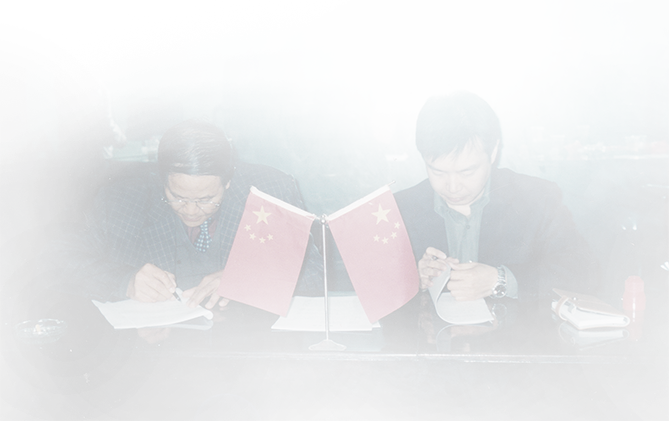
A historic signing moment from the 1970s, when HG’s founder helped drive the development of China’s food industry and began expanding into international markets.
Over the past decades, we have participated in the evolution of automated food production — from local factories to global turnkey projects across 100+ countries. That experience continues to shape every HG production line today.
Discover Our Heritage
Global Food Machinery &
Turnkey Factory Solutions

Building Long-Term Partnerships Through Shared Growth and Industrial Value.
Copyright © HG Industry Group All Rights Reserved
Food Machine Snack Food Processing Machinery

Unauthorized use of this website's content constitutes copyright infringement and may result in legal action.