 English
 中文简体
 日本語
 русский
 عربى
 Український
 Español
 Français

Automatic Natural Potato Chips Production Line: A Complete Guide for Manufacturers
Content
- 1. Introduction
- 2. What Is an Automatic Natural Potato Chips Production Line?
- 3. Key Benefits of Automation
- 4. Production Process Step by Step
- Step 1: Potato selection, receiving and storage
- Step 2: Destoning and dry cleaning
- Step 3: Washing and peeling
- Step 4: Inspection and trimming
- Step 5: Slicing
- Step 6: Slice washing and starch removal
- Step 7: De-watering
- Step 8: Continuous frying
- Step 9: De-oiling
- Step 10: Seasoning
- Step 11: Cooling and inspection
- Step 12: Packaging
- 5. Main Equipment in the Production Line
- 6. Production Capacity Options
- 7. How to Make Truly “Natural” Potato Chips
- 8. Factors to Consider When Choosing a Production Line
- 9. Cost & ROI Analysis
- 10. How to Choose a Reliable Supplier
- 11. Common Challenges & Solutions
- 12. FAQ
- 13. Conclusion + CTA
1. Introduction
Natural potato chips, also called sliced or “real-slice” chips, are made from whole fresh potatoes that are washed, peeled, sliced, fried and seasoned. Consumers choose them for the visible potato texture, the short ingredient list and the authentic crunch. For manufacturers, that demand makes a well-designed automatic natural potato chips production line one of the most reliable ways to enter, or scale up in, the snack market.
This guide covers lines with a maximum capacity of 500 kg/h of finished chips, from small-batch and mid-size plants up to a fully continuous line. It explains the fresh-potato process in detail, describes the equipment, and shows how to estimate cost and return. It also states clearly how natural (sliced) chips differ from composite (fabricated) chips in raw materials, process flow and equipment, so you do not confuse the two product types when planning a factory.
2. What Is an Automatic Natural Potato Chips Production Line?
An automatic natural potato chips production line is an integrated set of machines that carries fresh potatoes through every stage, from the receiving hopper to the packaging machine, with minimal manual handling. Conveyors, elevators and level controls link the machines, while a central control panel (usually PLC-based, with touchscreen) manages temperatures, speeds and frying time.
The defining feature of a natural chip is that the slice is cut directly from a whole potato, so the cell structure of the potato is preserved. This is what gives the chip its irregular surface, slight curl and “bite”. No dough is made, and the product is not molded.
Typical output range of this line type
- Semi-automatic / small batch: 50–100 kg/h
- Entry-level automatic: 100–200 kg/h
- Mid-scale continuous: 200–300 kg/h
- Maximum scale covered here: up to 500 kg/h
Beyond 500 kg/h, plants normally move to large industrial layouts (steam peeling, multi-line slicing, large continuous fryers with thermal-oil heating and dedicated starch and wastewater systems), which are a different engineering project.
3. Key Benefits of Automation
- Consistent quality. Slice thickness, frying temperature and residence time are controlled to tight tolerances, so color, crispness and oil content are repeatable from batch to batch.
- Lower labor cost. A 500 kg/h line can typically be run by a small crew per shift, compared with many more people for manual or semi-manual lines.
- Better yield. Optimized peeling, slicing and de-oiling reduce raw-potato loss and oil carried out in the finished product.
- Food safety and hygiene. Stainless steel (SUS304) contact surfaces, enclosed conveying and less manual contact reduce contamination risk and simplify HACCP or BRC/FSSC-style audits.
- Energy and oil efficiency. Heat recovery, oil filtration and temperature control lower the cost per kilogram.
- Scalability. A modular design lets you start at 100–200 kg/h and extend the line (a second fryer, extra slicer, more packing capacity) as sales grow.
4. Production Process Step by Step
The following flow describes a continuous natural chip line. Typical values are given as a guide; always validate them for your potato variety and oil.
Step 1: Potato selection, receiving and storage
Raw-material quality decides most of the final result. Chipping potatoes should have:
- High dry matter (roughly 20–24%, or specific gravity around 1.080 or higher), which gives lower oil uptake and a crisper chip.
- Low reducing sugars (glucose and fructose, ideally below about 0.25% of fresh weight). High sugar causes dark, bitter chips and more acrylamide through the Maillard reaction.
- Round to oval shape, uniform size (commonly 40–75 mm diameter), shallow eyes and few defects.
Common chipping varieties include Atlantic, Snowden, Lady Rosetta, Hermes, FL1879 and many local varieties bred for processing. Store potatoes in ventilated, dark storage at about 8–10 °C. Colder storage converts starch to sugar (“cold sweetening”), and warmer storage encourages sprouting and rot. If potatoes have been stored cold, a reconditioning period at warmer temperature can lower sugar levels before processing.
Step 2: Destoning and dry cleaning
Potatoes are fed from a hopper onto a conveyor or a destoner, where stones, soil clods and foreign material are removed. This protects the peeler and slicer blades.
Step 3: Washing and peeling
A bubble or brush washer removes soil. At up to 500 kg/h, abrasive (carborundum) roller peelers or brush-roller peelers are the common choice. Peeling time is set so that skin is removed with the smallest possible loss of flesh; typical peeling loss is around 8–15% depending on potato shape and skin condition. Peel waste is separated by water and collected as by-product (animal feed or composting).
Step 4: Inspection and trimming
Peeled potatoes pass over an inspection conveyor where operators remove green spots, dark defects, remaining eyes and rotten pieces. Green potatoes contain elevated solanine and must be rejected.
Step 5: Slicing
A centrifugal slicer cuts potatoes into uniform slices, usually 1.1–1.8 mm thick for classic chips. Wavy (crinkle) blades are available for ridged chips. Slice thickness matters: thicker slices fry slower and give a harder bite; thinner slices fry faster and can scorch. Sharp, well-maintained blades give a clean cut and less free starch on the surface.
Step 6: Slice washing and starch removal
Freshly cut slices are washed in water (often cool, and sometimes with a short warm blanch in the range of about 60–85 °C) to remove surface starch. This prevents slices from sticking together, improves color and can reduce acrylamide formation. Washed starch is recovered in a settling or filtration unit; this keeps wastewater load manageable and allows starch to be sold as a by-product.
Step 7: De-watering
Surface water is removed with a vibrating screen, air knife or centrifugal dewatering unit before frying. This step is easy to underestimate: extra water entering the fryer lowers oil temperature, speeds up oil degradation and creates uneven product.
Step 8: Continuous frying
Slices enter a continuous fryer where paddles or a submerged conveyor keep them moving through hot oil. Typical oil temperature is 165–190 °C with a residence time of roughly 2–4 minutes, with the temperature profile (hotter at the inlet, slightly cooler toward the outlet) adjusted to control color. The target is a finished moisture content of about 1.5–2%. The fryer is heated by electricity, gas or thermal oil, and an integrated filtration circuit removes fines to extend oil life. Oil is topped up continuously, which is an important factor in keeping oil quality stable.
For very small output, batch (kettle-style) fryers produce a harder, thicker “kettle chip” texture. They are a good fit for premium niche products but are not suitable for a true high-capacity automatic line.
Step 9: De-oiling
Fried chips carry surface oil. A centrifugal de-oiler, vibrating oil-drain conveyor or hot-air blower removes the excess. Finished natural chips typically contain around 28–35% oil by weight; good de-oiling lowers this, improving shelf life and giving a lighter product.
Step 10: Seasoning
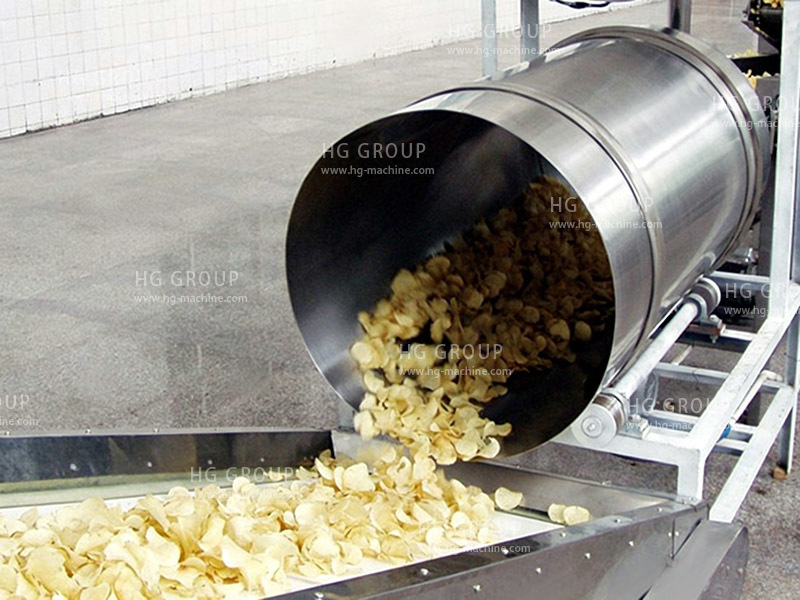
Chips travel through a seasoning drum or octagonal tumbler. A metering system doses powder seasoning, with an oil spray (often a small amount of oil) helping adhesion. Salt-only, sea-salt, paprika, onion, sour cream and many other flavors can be run, and the seasoning feeder is usually synchronized with the chip flow rate so the dosage stays constant.
Step 11: Cooling and inspection
Chips cool on a conveyor before packing, which prevents condensation inside the pack. A final visual or optical sorter removes burnt, dark or defective chips.
Step 12: Packaging
A multi-head weigher feeds a vertical form-fill-seal (VFFS) machine, which makes pillow bags and flushes them with nitrogen to protect against oxidation and breakage. A metal detector and a checkweigher complete the line, followed by case packing.
5. Main Equipment in the Production Line
A complete 500 kg/h natural potato chips line typically includes:
|
Section |
Equipment |
Function |
|
Feeding |
Hopper, elevator, destoner |
Controlled feed, removes stones and soil |
|
Cleaning & peeling |
Bubble/brush washer, abrasive roller peeler |
Removes dirt and skin |
|
Inspection |
Trimming/inspection conveyor |
Manual removal of defects |
|
Slicing |
Centrifugal slicer (plain or crinkle blades) |
Uniform slices |
|
Slice treatment |
Slice washer, blanching unit (optional), starch recovery |
Removes surface starch, improves color |
|
De-watering |
Vibrating screen / air knife / centrifuge |
Removes surface water |
|
Frying |
Continuous fryer, oil filtration, heating system (electric/gas/thermal oil) |
Cooks and crisps slices |
|
De-oiling |
Centrifugal or vibrating de-oiler |
Lowers surface oil |
|
Seasoning |
Seasoning drum, powder feeder |
Even flavor coating |
|
Cooling |
Cooling/inspection conveyor |
Prepares chips for packing |
|
Packaging |
Multi-head weigher, VFFS machine, nitrogen unit, metal detector, checkweigher |
Weighing, bagging, protecting, inspecting |
|
Utilities |
Control cabinet (PLC), exhaust hood, wastewater treatment |
Control, safety, environmental compliance |
Material and build quality are worth checking at this stage: food-grade SUS304 stainless steel for all product-contact parts, well-sealed bearings, accessible cleaning points and an electrical system that meets the standards of your country (CE, UL or equivalent).
6. Production Capacity Options
Capacity here refers to finished chips per hour. Because natural chips lose a lot of mass during peeling and frying, fresh-potato consumption is much higher. As a rule of thumb, you will need approximately 3.5–4.5 kg of fresh potatoes for each 1 kg of finished chips, depending on dry matter, peeling loss and final oil content. Always confirm whether a supplier’s stated capacity refers to finished product or raw input.
|
Line size |
Finished chips |
Approx. fresh potato input |
Typical use |
|
Small |
50–100 kg/h |
200–450 kg/h |
Start-ups, regional brands, premium kettle-style |
|
Medium |
100–200 kg/h |
400–900 kg/h |
Growing regional producers |
|
Medium-large |
200–300 kg/h |
800–1,350 kg/h |
Established brands, contract packers |
|
Maximum |
up to 500 kg/h |
1,750–2,250 kg/h |
Large regional manufacturers |
The fryer is usually the bottleneck. At 500 kg/h, the line will normally need a larger continuous fryer, a stronger heating system (thermal oil or gas is common), more powerful oil filtration and a larger packaging section, often two VFFS machines.
7. How to Make Truly “Natural” Potato Chips
7.1 What “natural” means in practice
There is no single global legal definition of “natural” for snack foods, and rules vary by country, so check your local labeling regulations before printing the word on a pack. In the chip industry, “natural” usually means:
- Made from whole, fresh potatoes(not reconstituted dough)
- A short ingredient list: potatoes, oil, salt, plus natural seasonings
- No artificial colors, flavors or preservatives
- Often non-GMO and fried in minimally processed oils (for example high-oleic sunflower, sunflower, rice bran or palm olein)
To make this work in production, control the raw material (low-sugar potatoes), keep frying temperature stable, use clean, regularly filtered oil, and use natural seasoning powders.
7.2 Natural chips vs. composite (fabricated) chips
These are two different product families. Mixing up their process or equipment is a common planning mistake, so the key differences are summarized below.
|
Aspect |
Natural (sliced) potato chips |
Composite / fabricated potato chips |
|
Main raw material |
Whole fresh potatoes |
Potato flakes, granules or starch, often blended with wheat, corn or rice flour |
|
Other ingredients |
Oil, salt, seasoning |
Water, emulsifiers, flavors, sometimes antioxidants and other additives, plus oil and seasoning |
|
Starting step |
Washing and peeling potatoes |
Mixing the dry ingredients with water to make dough |
|
Shaping |
Slicing the potato directly |
Sheeting dough into a thin sheet, cutting or stamping, sometimes forming into a saddle shape on molds |
|
Cell structure |
Original potato cell structure is preserved |
Structure is rebuilt from dough, so texture is uniform and more engineered |
|
Frying |
Longer, usually 2–4 minutes in a continuous fryer, then de-oiled |
Short frying time (often seconds), or baking, and stackable chips are typically fried in molds |
|
Shape and appearance |
Irregular, with natural surface blemishes, curls and color variation |
Uniform shape, color and size, easy to pack in tubes |
|
Key equipment |
Washer, peeler, slicer, starch-washing unit, continuous fryer |
Dough mixer, sheeter, cutter or forming machine, fryer or oven, molds |
|
Equipment not needed |
Dough mixer, sheeter, molds |
Peeler, slicer, starch-recovery unit |
|
Raw-material yield |
Roughly 3.5–4.5 kg potatoes per kg of chips |
Higher control of yield since ingredients are dry and uniform |
|
Ingredient label |
Short, clean-label |
Longer, with multiple ingredients |
|
Typical packaging |
Pillow bags |
Tubes or bags, depending on shape |
In short, a natural line is a peel-slice-fry line, while a composite line is a mix-sheet-form-fry line. If your brand story is “real potatoes” and a clean label, choose the natural line described here.
8. Factors to Consider When Choosing a Production Line
- Target capacity.Choose a capacity based on a realistic three-year sales forecast. A modular 200–300 kg/h line you can extend is often safer than buying 500 kg/h on day one.
- Potato supply.Check whether you can secure chipping-grade potatoes, stored properly, all year round. A 500 kg/h line consumes roughly 15–18 tonnes of potatoes in an 8-hour shift.
- Product style.Plain, crinkle or kettle-style? Each changes slicer blades and frying setup.
- Heating method.Electricity, gas, diesel or thermal oil. Local energy price should drive the decision.
- Oil management.Filtration, oil top-up systems and temperature control directly affect cost and quality.
- Space and utilities.A 500 kg/h line may need around 600–1,000 m² including storage, and requires adequate water, power, steam or gas and drainage.
- Wastewater and by-products.Plan for peel waste, starch water and oil-laden air. Environmental rules can be strict.
- Automation level.Decide which steps you automate (for example trimming and packing may remain semi-manual in lower-capacity versions).
- Certification and standards.Confirm the machine meets CE or other regional safety standards and your food-safety scheme.
- After-sales support.Spare parts, remote support, installation and training are as important as the machine itself.
9. Cost & ROI Analysis
9.1 Indicative investment
Prices vary widely by country, automation level, material and brand. The figures below are rough planning ranges only; ask suppliers for itemized quotations.
|
Line size |
Indicative equipment cost (USD) |
|
50–100 kg/h |
$30,000–$90,000 |
|
100–200 kg/h |
$80,000–$200,000 |
|
200–300 kg/h |
$180,000–$350,000 |
|
up to 500 kg/h |
$300,000–$600,000+ |
Budget extra for freight, installation, building and utilities, wastewater treatment, packaging materials, working capital, training and permits. Total project cost is often 1.5–2 times the equipment price.
9.2 Operating cost per kg of chips
Main variable costs are:
- Potatoes(3.5–4.5 kg per kg of chips), usually the largest cost
- Frying oil(roughly 0.3–0.4 kg absorbed per kg of chips, plus filtration losses)
- Seasoning, packaging film and cartons
- Energy(electricity, gas or thermal oil, and water)
- Labor and maintenance
9.3 Illustrative ROI example
The numbers below are assumptions for illustration only. Replace them with your local potato, oil, labor and selling prices.
|
Item |
Assumption |
|
Line capacity |
500 kg/h finished chips |
|
Operation |
8 h/day, 300 days/year, 70% utilization |
|
Annual output |
about 840 tonnes |
|
Contribution after variable costs |
$0.60 per kg |
|
Annual contribution |
about $504,000 |
|
Fixed costs (labor, maintenance, overhead, marketing) |
about $200,000/year |
|
Annual operating profit |
about $304,000 |
|
Total project investment |
about $600,000 |
|
Simple payback |
roughly 2 years |
In practice, payback depends mostly on utilization, yield, selling price and market access. A line that runs only half the planned hours or loses 3–4% more potato in peeling can change the return significantly, so test these sensitivities before you buy.
10. How to Choose a Reliable Supplier
- Proven experiencein natural potato chip lines specifically, not only snack lines in general. Ask for customers with similar capacity and request references.
- Technical transparency.A good supplier gives a clear flow chart, mass balance (potato in, chips out, waste) and utilities list, and states whether capacity is per finished product or raw input.
- Factory visit or live demonstration.See the line run with your potatoes if possible, or ask for a trial with a sample of your variety.
- Build quality.SUS304 contact surfaces, branded electrical and pneumatic components (for example Siemens, Schneider, Omron, SMC) and good welding.
- Ability to adapt to your potato variety, oil, heating source, plant layout and flavors.
- Installation and training.On-site commissioning, operator training and operation manuals in your language.
- Spare parts and service.Warranty terms, spare-parts lists and response time for support.
- Clear contract.Payment terms, delivery time, acceptance test (capacity, oil content, moisture, breakage rate) and what happens if the line fails to reach guaranteed performance.
11. Common Challenges & Solutions
|
Challenge |
Typical cause |
Solution |
|
Dark or brown chips |
High reducing sugars, old oil, too hot a fryer |
Use low-sugar potatoes, recondition stored potatoes, control temperature, refresh oil |
|
High acrylamide |
Sugars plus high frying temperature |
Better potato selection, blanch or wash slices, optimize temperature profile, consider asparaginase treatment where permitted |
|
High oil content |
Low dry matter, thick slices, poor de-oiling |
Select high dry matter varieties, adjust slice thickness, improve de-oiling |
|
Slices sticking together |
Surface starch |
Wash thoroughly, ensure good dewatering and slice separation |
|
Uneven color or soft chips |
Wet slices, uneven slice thickness, poor oil flow |
Improve dewatering, sharpen blades, check paddles and oil circulation |
|
Broken chips |
Rough handling, long drops, over-drying |
Gentler conveyors, shorter drops, correct moisture, nitrogen-filled bags |
|
Off flavors or short shelf life |
Oxidized oil, high moisture, poor packaging |
Filter and replace oil, keep moisture ≤2%, use high-barrier film and nitrogen flushing |
|
Excess waste |
Aggressive peeling, small or irregular potatoes |
Grade potatoes, optimize peeler time, reuse by-products |
|
High wastewater load |
Starch and peel water |
Install starch recovery, settling tanks and a suitable treatment system |
12. FAQ
What is the maximum capacity of this production line? The line described in this guide goes up to 500 kg/h of finished chips. Larger capacities typically need a different, fully industrial plant design.
How many potatoes do I need per hour for 500 kg/h of chips? About 1,750–2,250 kg of fresh potatoes per hour, depending on dry matter, peeling loss and oil content.
Can the same line produce fabricated chips? No. Fabricated (composite) chips are made from dough and need a mixer, sheeter, cutter or molding system. A natural line has a peeler and slicer instead. Only the fryer, seasoning and packaging sections may be partly shared in concept.
Can the line make both plain and crinkle chips? Yes, in most cases by changing the slicer blades. Seasoning and frying settings may need slight adjustment.
What oil is best for natural potato chips? High-oleic sunflower, sunflower, rice bran and palm olein are common. Choose based on flavor, stability, price, labeling and local consumer preference.
What moisture should finished chips have? About 1.5–2% at the fryer outlet. Higher moisture makes chips soft and shortens shelf life.
How long does installation take? Typically 1–3 months from delivery, depending on line size and site readiness, plus a commissioning and training period.
Can I start with a smaller line and expand? Yes. A modular design lets you add a second fryer, slicer or packing line later. Discuss expansion plans with your supplier before the first purchase.
13. Conclusion + CTA
An automatic natural potato chips production line gives manufacturers a dependable way to produce real-potato, clean-label chips at consistent quality and competitive cost. Success depends on a few fundamentals: good chipping potatoes, a properly sized line (up to 500 kg/h), stable frying and de-oiling, hygienic design and a supplier who understands the natural sliced-chip process rather than fabricated dough-based chips.
If you are planning a new factory or upgrading an existing one, start by defining your target capacity, potato source, product style and budget. Then ask potential suppliers for a flow chart, mass balance, layout and itemized quotation.
Ready to plan your natural potato chips line? Contact our team with your target capacity (50–500 kg/h), potato variety, heating source and flavors, and we will provide a customized process flow, equipment list, layout drawing and quotation.
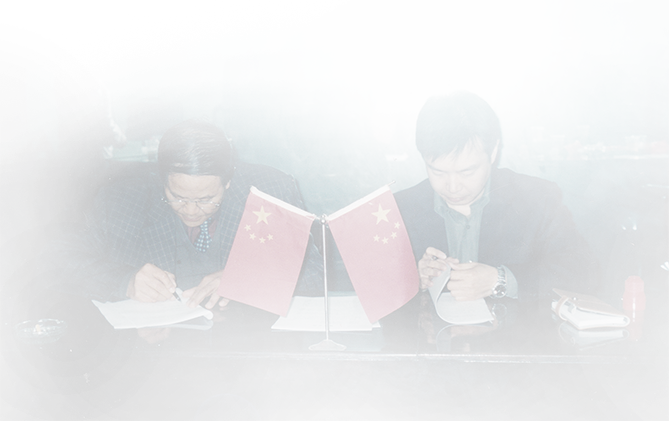
A historic signing moment from the 1970s, when HG’s founder helped drive the development of China’s food industry and began expanding into international markets.
Over the past decades, we have participated in the evolution of automated food production — from local factories to global turnkey projects across 100+ countries. That experience continues to shape every HG production line today.
Discover Our Heritage
Global Food Machinery &
Turnkey Factory Solutions

Building Long-Term Partnerships Through Shared Growth and Industrial Value.
Copyright © HG Industry Group All Rights Reserved
Food Machine Snack Food Processing Machinery

Unauthorized use of this website's content constitutes copyright infringement and may result in legal action.