 English
 中文简体
 日本語
 русский
 عربى
 Український
 Español
 Français

Automatic Compound Potato Chips Production Line: Complete Guide for Snack Manufacturers
Content
- 1. Introduction
- 2. What Is a Compound Potato Chips Production Line?
- 3. How an Automatic Compound Potato Chips Production Line Works
- 4. Key Equipment in the Production Line
- 5. Advantages of an Automatic Compound Potato Chips Production Line
- 6. Production Capacity & Configuration Options
- 7. How to Choose the Right Production Line Supplier
- 8. Cost of an Automatic Compound Potato Chips Production Line
- 9. Applications and Product Variety
- 10. FAQ
- 11. Conclusion
1. Introduction
Compound (fabricated) potato chips have become a mainstay of the global snack market. Because they are made from potato powder instead of sliced fresh potatoes, they offer what many manufacturers struggle to achieve with natural-cut chips: uniform shape, stable quality, controllable nutrition, and unlimited flavor possibilities. Stackable “tube” chips, saddle-shaped chips and other formed snacks all come from this process.
For snack manufacturers, the real question is no longer whether to invest in compound chips, but how to build a line that runs stably today and can still grow with the business tomorrow. An automatic compound potato chips production line from HG Industry Group is designed around that goal: a fully automated process from mixing to flavoring, with capacity options that scale up to 750 kg/h, and a proven record of helping customers expand, including a Turkish factory that upgraded to 1000 kg/h.
This guide walks through how the line works, the equipment it includes, how to configure capacity, how to choose a supplier, and what a real expansion project looks like.
2. What Is a Compound Potato Chips Production Line?
A compound potato chips production line turns potato powder (potato flakes or granules), starch and water into dough, presses the dough into thin sheets, cuts and shapes the chips, fries them, and then seasons and packs them.
Compared with traditional sliced chips, compound chips have clear advantages:
- Consistent size and shape: every chip looks the same, which makes stacking and packaging easy.
- Controllable formulation: fat, salt, fiber and other ingredients can be adjusted.
- Stable raw material supply: potato powder is not seasonal and is easy to store.
- Lower raw material loss: no peeling waste, no sugar-content problems of fresh potatoes.
- Wide product variety: shapes, thickness and flavors can be changed quickly.
HG’s fully automatic line was developed on the basis of European and American technologies. It took more than one year of research and development, and it has become a preferred investment project for food manufacturers who want a reliable, high-automation snack line.
3. How an Automatic Compound Potato Chips Production Line Works
The process follows five main stages: mixing, pressing, forming, frying and flavoring, followed by packing.
Step 1: Mixing. Potato powder, starch, water and additives are blended in a dough mixer according to the recipe. Even mixing and correct moisture are critical, because they decide how the dough behaves in later stages.
Step 2: Pressing (sheeting). The dough is conveyed to a multi-stage pressing system, where rollers press it into a continuous sheet. Precision here determines the final thickness. HG’s line holds chip thickness tolerance within 0.8 mm, which keeps frying results and texture consistent.
Step 3: Forming. The sheet is cut into the desired shape (round, oval, rectangular, or saddle-shaped for stackable chips). Scrap dough is recycled back into the system to reduce waste.
Step 4: Frying. The formed chips enter the fryer, where oil temperature must be held within a narrow window. HG’s fryer controls temperature to within ±2°C, giving uniform color, crispness and oil content. A complete oil filtration and circulation system keeps oil clean, extends oil life and makes cleaning and maintenance easier.
Step 5: De-oiling and flavoring. After frying, excess oil is removed and the chips go through a seasoning drum or seasoning system, where flavor is applied evenly.
Step 6: Packing. Finished chips are conveyed to packaging equipment. HG lines are compatible with vertical packing machines, pillow packing machines and paper tube (canister) packing machines, so customers can choose the format that fits their market.
4. Key Equipment in the Production Line
A complete line normally includes the following equipment:
| Section | Equipment | Function |
|---|---|---|
| Dough preparation | Dough mixer, powder feeding system | Mixes potato powder, starch and water into uniform dough |
| Sheeting | Multi-roller dough pressing machine | Presses dough into a thin, even sheet |
| Forming | Cutting/forming machine, scrap return conveyor | Cuts and shapes chips, recycles scrap |
| Frying | Continuous fryer, heating system (electric, gas or fuel-fired), oil filtration and circulation | Fries chips at precise temperature |
| De-oiling | De-oiling machine / vibrating conveyor | Removes surface oil |
| Seasoning | Seasoning drum, seasoning feeder | Applies flavor evenly |
| Packing | Vertical, pillow or paper tube packing machine | Packages finished chips |
| Control | PLC control cabinet | Coordinates the full line |
Build quality: The line is made of 304 stainless steel with imported electronic components, supporting long-term stable operation and high automation. HG also holds over 30 patented technologies across the line, and physical prototypes are available at HG’s factory for customer visits and trials.

5. Advantages of an Automatic Compound Potato Chips Production Line
High automation, lower labor cost. From mixing to seasoning, the line needs few operators, which reduces labor dependency and human error.
Consistent quality. Tight control of thickness (within 0.8 mm) and temperature (±2°C) means uniform color, texture and appearance in every batch.
Stable long-term operation. 304 stainless steel and imported electrical parts reduce breakdowns and downtime.
Easy cleaning and maintenance. The oil filtration and circulation system keeps frying oil in good condition and simplifies cleaning routines.
Flexible products. By changing molds, recipes and seasonings, one line can produce many chip types.
Energy-conscious design. Heating options (electric, gas or fuel) and optimized structure let manufacturers match the line to local energy costs.
Scalable. A well-designed line can be configured at different capacities and upgraded later, which is where HG’s project experience matters most (see Section 6 and the Turkey case).
6. Production Capacity & Configuration Options
HG’s standard compound potato chips line is offered in multiple capacities. The table below compares two commonly used configurations:
| Parameter | 250 kg/h line | 500 kg/h line |
|---|---|---|
| Production capacity | 250 kg/h | 500 kg/h |
| Installed power | 130 kW | 150 kW |
| Fuel consumption | 25 kg/h | 35 kg/h |
| Gas consumption | 25–30 m³/h | 40–50 m³/h |
| Equipment length | 40 m | 40 m |
Two things stand out. First, doubling capacity from 250 to 500 kg/h increases installed power only from 130 to 150 kW, so the energy cost per kilogram drops significantly. Second, the equipment length stays at 40 m, which means a manufacturer can often scale up without needing a much larger workshop.
For larger plants, HG’s compound chips line can be configured up to 750 kg/h in a standard single-line design. For manufacturers who need even more, HG provides customized upgrade solutions, as shown in the case below.
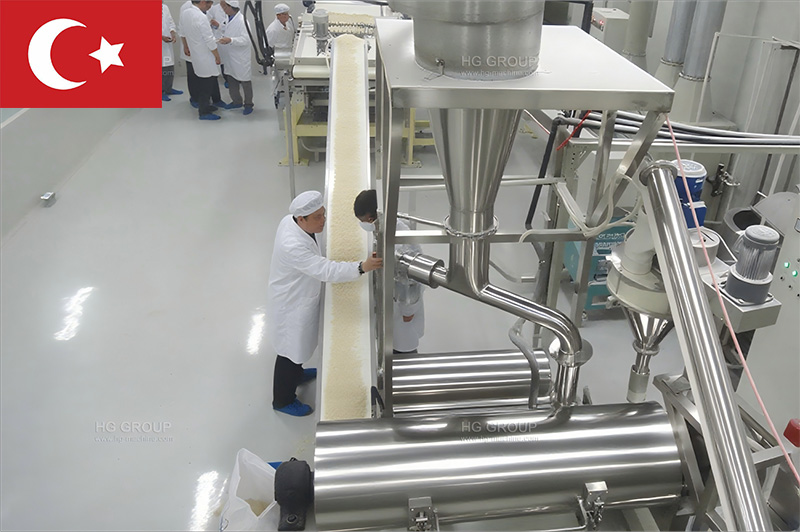
Real Project Case: Turkey Potato Chip Factory Upgraded to 1000 kg/h
Background. A potato chip manufacturer in Turkey was already producing compound chips but faced growing market demand. Their existing capacity could no longer keep up with orders from retail and distribution customers, and they wanted a larger, more efficient line without sacrificing product quality.
The challenge. Expanding output is not just a matter of making machines bigger. Higher capacity puts pressure on every stage:
- Dough preparation must supply a larger, steadier volume.
- Sheeting and forming must maintain thickness accuracy at higher speed.
- The fryer must keep temperature and oil quality stable under heavier load.
- Seasoning and packing must keep pace so the line does not bottleneck.
- Energy use and floor space must stay under control.
HG’s solution. HG’s engineering team reviewed the customer’s production goals and plant conditions and designed an upgraded configuration with a target capacity of 1000 kg/h. The solution retained the proven HG process (mixing, pressing, forming, frying, flavoring) and focused on:
- Matched capacity across all stages, so no single machine limits the line.
- Precise thickness and temperature control, maintaining the 0.8 mm thickness tolerance and ±2°C frying accuracy that protect product consistency at higher volume.
- A complete oil filtration and circulation system to keep oil quality stable during continuous high-volume frying.
- Flexible packing integration, so the customer could connect packaging equipment suited to their market.
- Stable, automated operation using 304 stainless steel and imported electronic components.
Result. The Turkish factory reached 1000 kg/h, doubling the output level of a standard 500 kg/h line while maintaining uniform color, crispness and appearance. The project shows that HG can do more than sell a fixed model: it can plan, configure and deliver capacity upgrades according to a customer’s growth needs.
Why it matters for you. If your business is starting at 250 kg/h today but expects demand to double, HG can help you plan the line so that future expansion is practical rather than a full replacement.
7. How to Choose the Right Production Line Supplier
Buying a production line is a long-term investment. When comparing suppliers, look beyond the price list:
- Process know-how. Does the supplier truly understand the compound chips process, not just machine manufacturing? Ask about R&D history. HG spent more than a year developing its line based on European and American technology.
- Control accuracy. Ask for specifications: thickness tolerance, temperature control, oil system design. HG offers ±0.8 mm and ±2°C.
- Material and component quality. Look for 304 stainless steel and imported electrical components.
- Patents and innovation. HG holds more than 30 patented technologies.
- Proven projects. Ask for real cases, especially expansion projects, like the Turkey 1000 kg/h upgrade.
- Physical prototype and testing. A supplier with prototypes you can visit and test reduces your risk.
- Packaging compatibility. Make sure the supplier can integrate vertical, pillow or tube packing.
- After-sales and installation support. Installation, training, spare parts and technical support matter as much as the machine.
- Scalability. Choose a supplier who can support future capacity upgrades.
8. Cost of an Automatic Compound Potato Chips Production Line
The investment varies widely, so any quoted figure should be treated as a starting point rather than a final price. The main cost factors are:
- Capacity: 250, 500, 750 kg/h or custom larger configurations.
- Heating method: electric, gas or fuel-fired systems differ in equipment cost and running cost.
- Automation level: the degree of automation in feeding, conveying and packing.
- Packaging choice: vertical, pillow or paper tube packing machines.
- Product variety: extra molds, seasoning systems or shape options.
- Workshop and utilities: the cost of installation, power, gas and water.
Think in total cost, not only purchase price. Operating costs, including energy, oil, labor, maintenance and waste, often exceed the equipment price over several years. Higher-capacity configurations typically lower the cost per kilogram, as the 250 vs. 500 kg/h comparison shows. For an accurate quotation, share your target output, product type, available space and energy conditions with HG.
9. Applications and Product Variety
HG’s compound chips line is suitable for:
- Snack food factories entering or expanding in the formed chips market.
- Private label and OEM producers who need flexible recipes and consistent quality.
- Regional brands moving from semi-automatic to fully automatic production.
- Established manufacturers looking to add capacity, as in the Turkish project.
Product possibilities include:
- Stackable chips in tube packaging
- Round, oval, rectangular or saddle-shaped chips
- Original, cheese, BBQ, sour cream and onion, spicy and other seasonings
- Multi-grain or nutrition-enhanced variants through recipe adjustment
- Different thickness levels to create different textures
10. FAQ
Q1: What raw material does the line use?
Potato powder (flakes or granules), usually combined with starch and water.
Q2: What is the maximum capacity of the standard line?
Up to 750 kg/h in the standard configuration. For larger needs, HG offers customized solutions, such as the 1000 kg/h Turkey project.
Q3: How much space does the line need?
The 250 kg/h and 500 kg/h lines are each about 40 m long. Final layout depends on your workshop and the selected packing system.
Q4: What heating methods are available?
Electric, gas and fuel-fired options, depending on your local energy costs and conditions.
Q5: How consistent is the product?
Thickness is controlled within 0.8 mm and frying temperature within ±2°C, producing uniform color and appearance.
Q6: What packaging machines can be connected?
Vertical packing machines, pillow packing machines and paper tube packing machines.
Q7: Is the equipment easy to clean?
Yes. The line has a complete oil filtration and circulation system, and its 304 stainless steel construction is easy to clean and maintain.
Q8: Can I upgrade capacity later?
Yes. HG has experience with capacity expansion projects and can help plan upgrades from the start.
Q9: Can I visit the factory or see the machine running?
Yes. HG has physical prototypes in its factory and welcomes customers to visit.
11. Conclusion
An automatic compound potato chips production line is one of the most reliable ways for snack manufacturers to build a stable, scalable and profitable business. The right line gives you consistent quality, controllable cost and room to grow.
HG Industry Group’s line combines European and American technology, 304 stainless steel construction, imported electronic components, over 30 patented technologies, ±0.8 mm thickness control and ±2°C temperature accuracy. With standard capacities from 250 kg/h to 750 kg/h and real expansion experience, such as the Turkey 1000 kg/h project, HG can support your factory today and as it grows.
Ready to Build or Expand Your Compound Chips Production?
Contact HG Industry Group today for a customized layout, capacity plan and quotation. Tell us your target output, product type and workshop conditions, and our engineers will recommend the right configuration.
Visit our factory to see the physical prototype and discuss your project with our team.
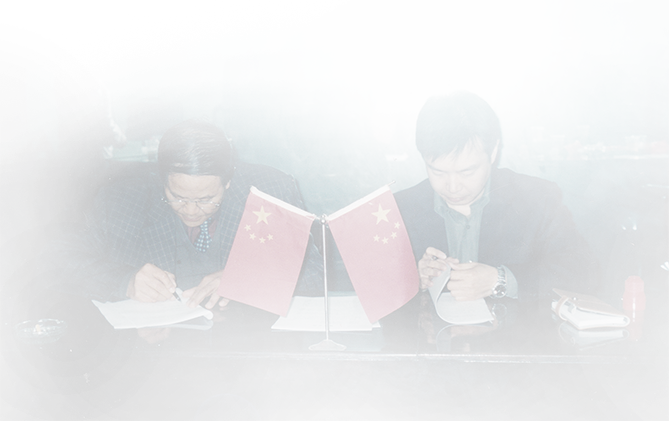
A historic signing moment from the 1970s, when HG’s founder helped drive the development of China’s food industry and began expanding into international markets.
Over the past decades, we have participated in the evolution of automated food production — from local factories to global turnkey projects across 100+ countries. That experience continues to shape every HG production line today.
Discover Our Heritage
Global Food Machinery &
Turnkey Factory Solutions

Building Long-Term Partnerships Through Shared Growth and Industrial Value.
Copyright © HG Industry Group All Rights Reserved
Food Machine Snack Food Processing Machinery

Unauthorized use of this website's content constitutes copyright infringement and may result in legal action.