 English
 中文简体
中文简体 日本語
日本語 русский
 عربى
عربى Український
 Español
 Français


4-Head Wafer Stick Production: Capacity, Bottlenecks and Accepted Output
Content
- 4-Head Wafer Stick Production: Capacity, Bottlenecks and Accepted Output
- Compare Capacity Under the Same Conditions
- Accepted Output Is More Important Than Theoretical Speed
- Head-to-Head Consistency
- Find the Next Bottleneck
- When Is Four-Head Production Suitable?
- Capacity Should Always Be Engineered as a System
4-Head Wafer Stick Production: Capacity, Bottlenecks and Accepted Output
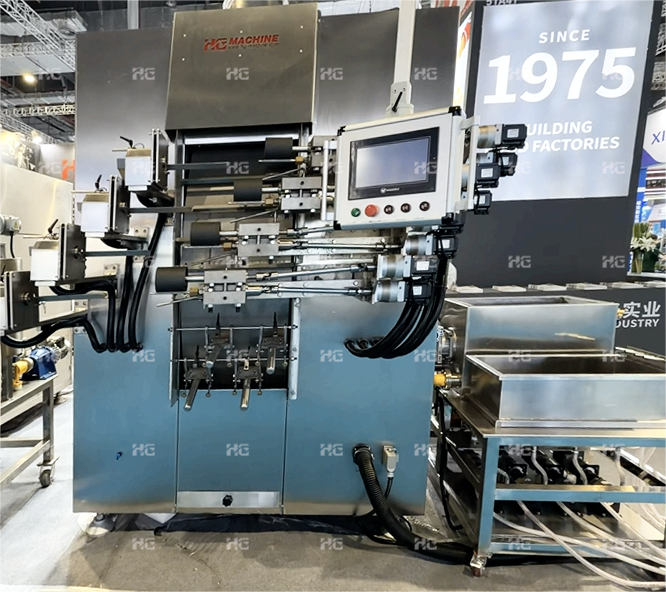
Four-head wafer stick production can significantly increase production opportunities.
But more heads do not automatically mean more saleable products.
The complete production line must be capable of receiving, cooling, transferring and handling the additional output.
Therefore, the correct question is not simply:
“How many heads does the machine have?”
It is:
“How much accepted product can the complete line consistently deliver?”
Compare Capacity Under the Same Conditions
A meaningful capacity comparison should use the same:
- Product diameter
- Product length
- Unit weight
- Filling proportion
- Measurement point
- Trial duration
A hollow wafer stick and a filled wafer stick cannot be fairly compared using one headline kg/h number.
Likewise, a longer product and a shorter product can have very different piece counts at the same mass output.
Accepted Output Is More Important Than Theoretical Speed
A useful capacity model is:
Accepted pieces/hour = production heads × pieces/minute/head × 60 × running-time fraction × acceptance fraction
For example, a hypothetical four-head system producing 10 pieces per minute per head, with 90% running time and 95% acceptance, would result in approximately 2,052 accepted pieces per hour.
This is an illustrative calculation only, not an HG machine specification.
The reason for using accepted output is simple:
A machine may have a high theoretical speed while the final accepted product is lower because of:
- Breakage
- Product instability
- Stoppages
- Manual intervention
- Downstream limitations
Head-to-Head Consistency
Four-head equipment also introduces another engineering question:
Are all working positions producing consistent products?
During an acceptance test, practical checks can include:
- Product dimensions
- Shell condition
- Filling consistency
- Product appearance
- Breakage
- Output from different working positions
High total output is less valuable if one working position repeatedly creates unstable products.
Find the Next Bottleneck
Increasing forming capacity increases the load on downstream systems.
For example:
4-head forming → higher product flow → cooling → transfer → arranging → packaging
If cooling or packaging cannot handle the increased flow, the additional production capacity may simply become accumulation or stoppage.
Therefore, four-head equipment should be engineered as part of a matched production line, not sold only as a higher head-count machine.
When Is Four-Head Production Suitable?
A four-head configuration may be appropriate when:
- Demand is sufficiently high
- The product family is clearly defined
- Downstream capacity is matched
- Continuous production is required
- The factory has sufficient space and utilities
In some cases, separate production lines may be better when the customer needs simultaneous products, independent production schedules or easier maintenance separation.
Capacity Should Always Be Engineered as a System
For HG, four-head technology is not simply a machine upgrade.
It is a capacity-engineering decision involving the entire production flow.
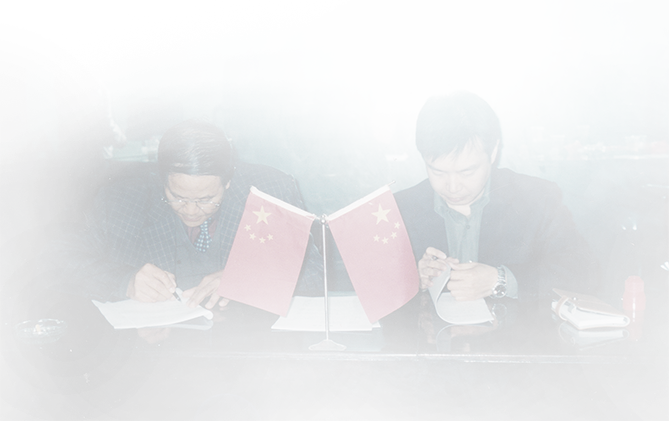
A historic signing moment from the 1970s, when HG’s founder helped drive the development of China’s food industry and began expanding into international markets.
Over the past decades, we have participated in the evolution of automated food production — from local factories to global turnkey projects across 100+ countries. That experience continues to shape every HG production line today.
Discover Our Heritage
Global Food Machinery &
Turnkey Factory Solutions

Building Long-Term Partnerships Through Shared Growth and Industrial Value.
Copyright © HG Industry Group All Rights Reserved
Food Machine Snack Food Processing Machinery

Unauthorized use of this website's content constitutes copyright infringement and may result in legal action.