 English
 中文简体
中文简体 日本語
日本語 русский
 عربى
عربى Український
 Español
 Français


Everything You Need to Know About a Potato Chips Line
Content
What a Potato Chips Line Actually Does
A potato chips line is a complete sequence of machines that takes raw potatoes and turns them into finished, packaged chips — ready for retail or bulk distribution. Rather than a single machine, it is an integrated production system where each piece of equipment feeds directly into the next, and the output quality at every stage affects everything downstream.
A well-configured chips manufacturing line typically handles washing, peeling, slicing, blanching, frying, de-oiling, flavoring, and packaging in a continuous flow. In modern automated setups, this entire sequence runs with minimal manual intervention, allowing factories to maintain consistent output volumes of 200 kg/h up to 2,000 kg/h or more, depending on line capacity.
Understanding what a potato chips production line includes — and how each stage interacts — is essential before investing in one, customizing an existing setup, or scaling a processing facility.
Core Stages in a Chips Production Line
Each stage in a potato chip processing line serves a specific technical purpose. Skipping or under-investing in any one of them usually creates problems — poor slice uniformity, high oil content, inconsistent flavoring, or accelerated oil degradation.
Washing and Peeling
Raw potatoes arrive with soil, surface bacteria, and skin that must be removed before slicing. Brush-type or abrasive roller washers are most common for high-volume lines. Peeling is typically done with carborundum rollers or steam peelers — steam peeling is preferred for large-scale operations because it minimizes peeling loss, with typical peel waste under 8–12% of raw weight compared to 15–18% for mechanical abrasion.
Slicing
Consistent slice thickness is one of the most critical variables in chip quality. Standard kettle-style chips use slices of 1.2–1.6 mm, while thinner continuous-process chips run at 0.9–1.2 mm. Centrifugal slicers with rotating impeller plates deliver high throughput, while linear blade slicers offer better thickness consistency for premium product lines. Blade wear tracking and automatic adjustment systems are worth the investment in high-volume lines, as even a 0.2 mm variance in slice thickness causes visible frying inconsistencies.
Blanching and Drying
Blanching removes surface starch released during slicing, which would otherwise cause chips to stick together during frying and produce an uneven, darker color. A hot water blanch at 70–80°C for 2–3 minutes is standard. Following blanching, a dewatering vibrator and an air-knife dryer remove surface moisture before the slices enter the fryer — reducing oil splatter and cutting frying energy consumption significantly.
Continuous Frying
The continuous fryer is the heart of the potato chips line. Oil temperature is typically maintained between 160°C and 175°C, with slice residence time in the oil of 2.5–4 minutes depending on thickness and desired moisture content. Paddle conveyor systems submerge and transport slices through the oil bath at controlled speed. Oil turnover rate — how frequently fresh oil replenishes the fryer — directly affects chip flavor and oil quality; well-designed fryers turn over oil continuously to minimize oxidation and free fatty acid buildup.
De-Oiling and Cooling
Immediately after frying, chips pass through a vibrating de-oiling conveyor where excess surface oil drains off, followed by a cooling tunnel that rapidly brings chip temperature down to ambient levels. Proper cooling prevents condensation inside packaging, which would cause softening and drastically reduce shelf life. A well-cooled chip leaving the line should reach below 35°C before entering the flavoring drum.
Flavoring
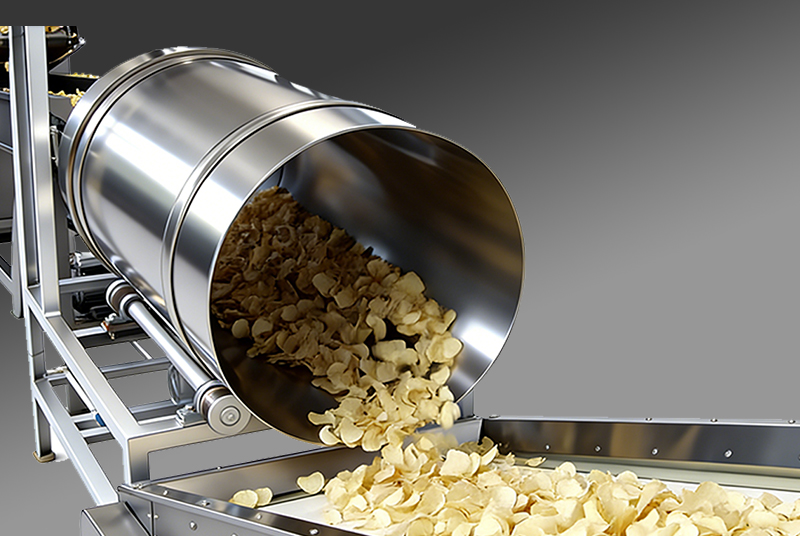
Seasoning is applied in a rotating drum coater where chips tumble against a fine spray or powder dispersal system. Seasoning adhesion depends on oil content still present on chip surfaces — which is why the timing between de-oiling and flavoring matters. Drum rotation speed and angle, spray nozzle placement, and seasoning feed rate are all adjustable parameters that affect coating uniformity. For multi-flavor lines, quick-change drum systems reduce product changeover time to under 15 minutes.
Packaging
Finished chips are transported via gentle elevator conveyor to multihead weighers — typically 14-head or 16-head scales — that portion chips to target weight with accuracy within ±1 g. The weighed portion drops into a vertical form-fill-seal (VFFS) machine that forms the bag, fills it with chips, injects nitrogen gas to protect against oxidation and breakage, and seals the package. Output speeds on modern VFFS chip lines reach 60–100 bags per minute for standard retail pack sizes.
Types of Potato Chips Lines by Scale and Output
Not every operation needs the same level of automation or throughput capacity. Chips processing lines are broadly categorized by output volume, which determines the degree of automation, equipment footprint, and capital investment required.
| Line Type | Typical Output | Automation Level | Best For |
|---|---|---|---|
| Small-Scale / Semi-Auto | 50–200 kg/h | Partial manual | Startups, regional brands |
| Mid-Scale Automated | 200–500 kg/h | Fully automated | Mid-size processors, private label |
| Industrial Continuous Line | 500–2,000+ kg/h | Fully automated + PLC/SCADA | National brands, contract manufacturers |
For a startup entering the snack market, a semi-automated line with a 100–150 kg/h capacity is often the most sensible entry point — it limits upfront capital exposure while still allowing consistent product quality. Scaling up later is more cost-effective than over-specifying at the start when demand is still being validated.
Key Specifications to Compare When Buying a Chips Line
When evaluating suppliers or configuring a new potato chip manufacturing line, several technical specifications deserve close attention beyond simple output rate. These directly affect product quality, operating cost, and long-term reliability.
- Fryer oil capacity and turnover rate: A fryer with continuous fresh oil inlet and overflow management keeps free fatty acid (FFA) levels below 0.5%, protecting chip flavor and extending oil life. Lines without this feature require full oil dump-and-replace cycles that create downtime and increase oil costs.
- Temperature control precision: PID temperature controllers on the fryer and blancher should maintain setpoint within ±2°C. Loose temperature control leads to variable chip color and inconsistent moisture content.
- Slicer blade material and replacement cost: High-carbon steel blades need replacing every 4–8 hours in high-volume operations. Tungsten carbide or coated blades last significantly longer but cost more upfront. Factor in total annual blade cost, not just purchase price.
- Cleaning-in-place (CIP) compatibility: Food-grade stainless construction (304 or 316L) with smooth internal surfaces that drain fully allows fast, chemical-assisted cleaning between production runs — critical for HACCP compliance and allergen control when running multiple flavors.
- Energy consumption per kg of output: A fully automated 500 kg/h line typically consumes 80–130 kWh per ton of finished product. Ask suppliers for verified energy figures — not theoretical minimums — and calculate total energy cost over a 5-year horizon when comparing quotes.
- Control system and remote diagnostics: Modern lines with PLC-based SCADA systems allow remote fault monitoring and parameter logging — reducing downtime and simplifying quality record-keeping for food safety audits.
Common Problems on Potato Chip Lines and How to Fix Them
Even well-configured lines encounter recurring issues. Knowing the root causes speeds up troubleshooting and prevents quality defects from reaching packaged product.
Dark or Uneven Chip Color
The most common cause is high reducing sugar content in the raw potato — especially in potatoes stored at low temperatures (below 8°C), where starch converts to sugars. Conditioning potatoes at 15–18°C for 1–2 weeks before processing reduces sugar levels. On the line, extending blanch time or lowering fryer temperature by 5–8°C can compensate for borderline raw material. Inconsistent slice thickness from blade wear is the second most common cause — check and replace blades on schedule.
High Oil Content in Finished Chips
Target oil content for standard chips is 28–35% by weight. If finished product is consistently above this range, the most likely culprits are insufficient pre-fry drying (too much surface moisture entering the fryer), fryer temperature running too low, or inadequate de-oiling after frying. Check the air-knife dryer throughput and verify oil temperature at multiple points across the fryer width — temperature gradients across wide fryers are common and often overlooked.
Chips Sticking Together or Breaking in the Fryer
Sticking indicates incomplete starch removal in the blanch stage — increase blanch water temperature or extend hold time. Breakage in the fryer paddle conveyor usually means paddle speed is too high or paddle spacing is too narrow for the slice thickness being used. Adjust both, and confirm the fryer loading rate is within equipment design spec — overloading the fryer with too much product causes clumping and uneven frying.
Uneven Seasoning Coverage
Poor seasoning adhesion usually traces back to either chips being too cool and dry entering the drum (reducing the surface oil available for seasoning to bind to) or drum rotation speed being incorrect for the batch size. For powder seasonings, electrostatic coating systems — now common on premium snack lines — dramatically improve coating uniformity and reduce seasoning waste by 15–25% compared to standard drum spray application.
Batch vs. Continuous Potato Chips Lines: Which to Choose
The choice between a batch-process kettle chip line and a continuous-process line is one of the most consequential decisions in potato chips production, and it is primarily a product and market decision — not just a cost one.
Continuous lines run product through the fryer in a steady flow, making them ideal for high-volume, consistent products like standard salted or lightly flavored chips. They offer lower labor cost per unit, tighter process control, and better suitability for large retail or foodservice volumes. However, they are less flexible for small-batch or specialty flavors, and changeover between products takes longer.
Batch kettle lines fry each batch separately in a rotating kettle, producing the denser, crunchier texture associated with kettle-cooked chip brands. They are inherently more flexible — flavors can change between batches with minimal line preparation — and the capital cost per unit of capacity is lower at small scale. The tradeoff is higher labor intensity and lower throughput. A typical kettle fryer processes one batch every 8–12 minutes, compared to the continuous output of a conveyor fryer.
Many mid-size processors operate both types — a continuous line for their mainstream volume SKUs and one or two kettle fryers for premium, limited-edition, or regional flavor variants. This combination maximizes both efficiency and product portfolio flexibility.
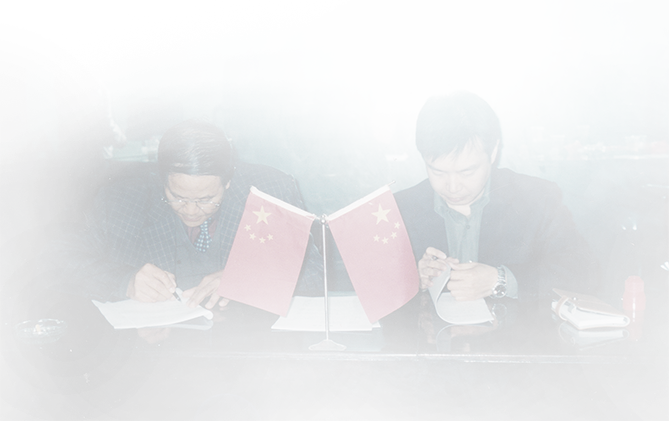
A historic signing moment from the 1970s, when HG’s founder helped drive the development of China’s food industry and began expanding into international markets.
Over the past decades, we have participated in the evolution of automated food production — from local factories to global turnkey projects across 100+ countries. That experience continues to shape every HG production line today.
Discover Our Heritage
Global Food Machinery &
Turnkey Factory Solutions

Building Long-Term Partnerships Through Shared Growth and Industrial Value.
Copyright © HG Industry Group All Rights Reserved
Food Machine Snack Food Processing Machinery

Unauthorized use of this website's content constitutes copyright infringement and may result in legal action.