 English
How efficient is the donut production line?
The donut’s origins trace back to the 19th century. One legend attributes its invention to the mother of American Captain Hanson, who pierced dough to solve the problem of undercooked centers during long voyages, creating a crispy-ringed treat that evolved into the modern donut.
In 1920, the advent of automated donut machines revolutionized production, shifting from artisanal craftsmanship to industrial scale and popularizing the snack globally. Post-1950s, fast-food culture propelled its proliferation, with innovations like glazing, fillings, and diverse shapes solidifying its status as a universal dessert icon.
Efficiency Benchmarks of Modern Donut Production Lines
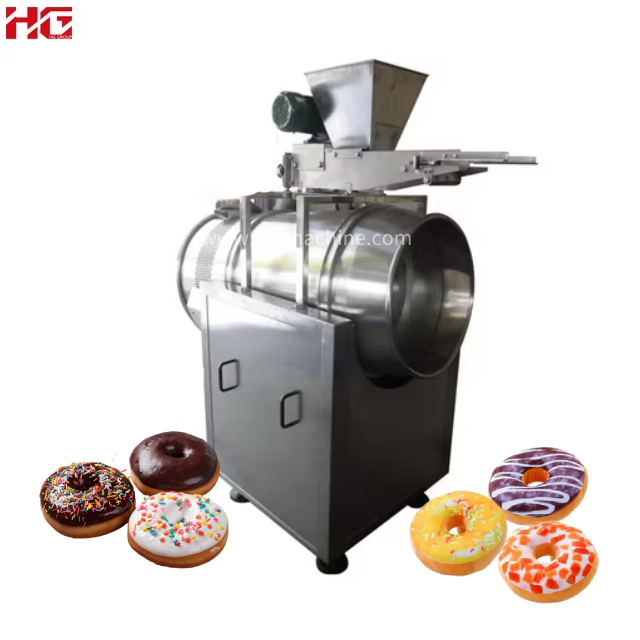
Efficiency in industrial donut production hinges on automation, precision engineering, and process integration. Shanghai Hengguang’s fully automated line exemplifies peak performance through:
High-Speed Continuous Output
Vibration Molding Technology: Generates 300-500 uniform dough pieces per minute with <1mm thickness variance.
24/7 Operation: Seamless integration from mixing to packaging enables uninterrupted production, with output scaling to 120,000+ units daily.
Rapid Changeover Capability
Tool-Free Mold Switching: Transitions between 15+ shapes (rings, twists, filled varieties) in ≤25 minutes, minimizing downtime.
Multi-Product Flexibility: Adapts to bagels, muffins, or specialty items via programmable PLC controls, optimizing asset utilization.
Labor & Waste Reduction
End-to-End Automation: Eliminates manual intervention across mixing, proofing, frying, and glazing, reducing labor costs by 60% and error rates by 95%.
Precision Portioning: Achieves ±0.5g weight accuracy, slashing raw material waste to <1.2% of total input.
Energy Optimization
Dual-Zone Frying System: German-engineered thermal oil heating reduces energy consumption by 12% compared to conventional fryers.
Intelligent Control Loops: Automated temperature and oil flow regulation ensure consistent product quality while extending oil life by 25%.
Performance Metrics
Typical Output: 8,000-15,000 units/hour (configurable based on dough density and product complexity).
OEE (Overall Equipment Effectiveness): Consistently exceeds 85%, outperforming industry averages by 20%.
Maintenance Downtime: <2% of operational hours, supported by predictive analytics and remote monitoring.
Ideal for large-scale manufacturers and global chains, these systems deliver unmatched throughput while maintaining ISO 22000 compliance and reducing operational costs. Custom configurations enable tailored solutions for diverse market demands, from premium artisanal batches to mass-market distribution.

Copyright Shanghai HG(hengguang) Food Machinery Co.,Ltd. All Rights Reserved
