 English
What Makes the Frozen French Fries Production Line Highly Efficient?
With the continuous development of the food processing industry, fried potato chips, as a food loved by consumers, the efficient operation of their production lines is becoming increasingly crucial. The fully automatic frozen French fries production line equipment, relying on advanced technology and elaborate design, has performance in production efficiency. Among them, the quick-freezing machine is the core of the entire production line, with high technical content and many significant advantages.
The production efficiency of the fully automatic frozen French fries production line is remarkable, which can meet the needs of large-scale production. Its production capacity range is wide, with an output of up to 500 kg and 1000 kg per hour, and can be customized according to the actual needs of enterprises.
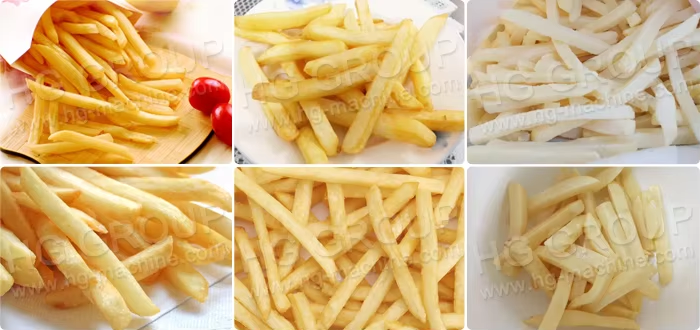
Why does the fully automatic frozen French fries production line equipment perform so excellently in terms of production efficiency?
I. Refrigeration system technology
Efficient refrigeration unit: It adopts advanced compressor refrigeration technology, such as high-end screw compressors, which have large refrigerating capacity, high energy efficiency ratio and stable operation. They can continuously provide sufficient and stable cold energy for the quick-freezing chamber, meeting the quick-freezing efficiency requirements of large-scale production.
Refrigerant optimization: New environmentally friendly refrigerants such as carbon dioxide are used to replace traditional ammonia refrigerants with safety risks. It is not only environmentally friendly, but also improves refrigeration efficiency and safety, and enhances the overall performance of the quick-freezing machine.
II. Airflow circulation technology
Uniform airflow distribution: Through the elaborately designed air duct and fan layout, the cold air is evenly distributed in the quick-freezing chamber, fully contacts with the potato chips, realizes rapid and uniform heat exchange, ensures that each potato chip has the same freezing effect, and avoids the impact of local temperature difference on quality.
Airflow speed control: With the help of an intelligent control system, the fan speed is automatically adjusted according to the needs of different stages of freezing. In the initial stage, high airflow speed is used to quickly dissipate heat, and when approaching the target temperature, the speed is reduced to prevent excessive freezing, so as to ensure the freezing effect.
III. Sanitary design technology
Material selection: The parts in contact with food are made of high-quality stainless steel, which is corrosion-resistant and easy to clean, preventing bacterial growth and pollution, and ensuring the hygiene and safety during the quick-freezing process.
Structural design: The gaps and corners in the equipment that are easy to accumulate dirt are reduced. The shell is welded seamlessly, and the conveyor belt, air duct and other parts are designed simply, which is convenient for cleaning and disinfection. Some equipment is also equipped with an automatic cleaning system to further improve the sanitary guarantee.
IV. Intelligent control technology
Automatic operation: Through the programmable logic controller (PLC) and human-machine interaction touch screen, parameters such as freezing temperature, time and airflow speed can be easily set and adjusted. The system operates automatically according to the preset program, realizing unattended operation, and improving efficiency and operation convenience.
Fault diagnosis and early warning: The equipment is equipped with multiple built-in sensors to monitor the operation status of key components in real time. In case of abnormal conditions, the system can quickly carry out fault diagnosis and notify the operators through sound and light alarms, so as to facilitate timely maintenance, avoid production interruption and reduce operational risks.

Copyright Shanghai HG(hengguang) Food Machinery Co.,Ltd. All Rights Reserved
