 English
The Engineering Behind the Crunch: How the Potato Chips Machine Transformed a Snack
From Humble Fry to Global Phenomenon
Potato chips—that crispy, salty, and utterly addictive snack—are an omnipresent part of modern life. But have you ever stopped to wonder how billions of bags of perfectly uniform chips are produced every year? The secret lies not in the potato itself, but in the sophisticated engineering marvel: the potato chips machine.
The journey from a raw potato to a crunchy chip is a fascinating blend of food science, chemical engineering, and automation. What started as a manual, labor-intensive process in the mid-19th century has been streamlined into a high-speed, continuous manufacturing line capable of processing tons of potatoes per hour.
The Manufacturing Marvel: Inside the Chips Factory
A modern potato chips machine is not a single device but an integrated system of specialized units working in perfect harmony.
The Preparation Phase: Cleaning and Peeling
The process begins with the raw material. Potatoes are trucked in, often stored in vast, climate-controlled silos. The first step is thorough washing to remove dirt and debris.
Next comes the peeling. Large-scale processors typically use an abrasive peeler—a massive cylinder lined with a rough surface that spins the potatoes, gently rubbing the skin away with minimal waste. Some modern machines use steam peeling, where the potatoes are briefly exposed to high-pressure steam, causing the skin to loosen instantly, which is then removed with a quick pressure change.
The Crucial Cut: Achieving Uniformity
This is arguably the most critical step for a quality chip: slicing. The peeled potatoes are fed into a high-speed rotary slicer. These precision instruments use a spinning impeller and a fixed set of razor-sharp blades to slice the potatoes into paper-thin, consistent wafers, typically around to millimeters thick.
Why is uniformity so important? Because an inconsistent slice thickness would lead to uneven cooking—some chips would be burnt while others would remain soggy. The precision of the slicer ensures that every chip enters the next phase with an equal chance of achieving perfect crispness.
The Transformation: Frying and Flavoring
Once sliced, the potato wafers are quickly rinsed to remove excess starch from the surface, which prevents clumping and reduces the risk of browning. They are then plunged into massive, continuous fryers.
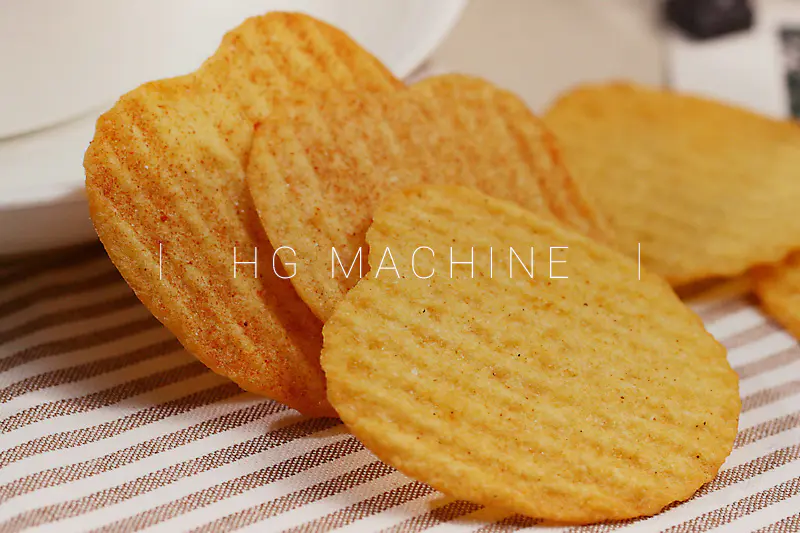
Continuous Frying Systems:
The Conveyor: A perforated conveyor belt carries the chips slowly through a bath of hot oil, typically sunflower, corn, or vegetable oil, maintained at a precise temperature (often between and ).
The Cook Time: The time in the fryer is brief, usually just a few minutes. This rapid cooking process quickly reduces the moisture content from about in a raw potato to less than in a finished chip. This moisture loss is what makes the chip crunchy.
Immediately after leaving the fryer, the chips are rapidly cooled and moved to the seasoning drum. This is a large, rotating cylinder where an atomized spray of oil and a precise dusting of salt and flavor powders are applied. The continuous rotation ensures every chip is evenly coated, achieving the perfect flavor balance.
The Final Steps: Quality Control and Packaging
Before the chips reach the bag, they pass through a critical quality control point.
Electronic Inspection
Advanced optical sorters or electronic eyes are used to scan the chips for defects. These machines use high-speed cameras and image processing software to identify chips that are over-cooked (too brown), misshapen, or still contain parts of the potato’s eye. Any defective chips are immediately ejected from the line by a quick puff of air, ensuring only the highest quality product moves forward.
The Packaging Efficiency
The chips are then weighed with extreme accuracy using a multihead weigher—a machine with multiple buckets that calculate the fastest combination of weights to hit the target weight with minimal give-away. Finally, a form-fill-seal machine grabs the correct weight of chips, forms the plastic film into a bag, seals it with heat, and fills the air with an inert gas, usually nitrogen, which acts as a preservative and provides the necessary cushioning to protect the delicate chips during shipping.
The entire automated process, driven by the modern potato chips machine, is a testament to the power of engineering to transform a simple root vegetable into one of the world’s most popular snacks, delivering consistent quality and crunch with every single bag.

Copyright Shanghai HG(hengguang) Food Machinery Co.,Ltd. All Rights Reserved
