 English
Inside a Modern Biscuit Production Line: Equipment, Process Control, and Efficiency Optimization
Overview of a Modern Biscuit Production Line
A biscuit production line is a fully integrated system designed to transform raw ingredients into finished, packaged biscuits with consistent quality and high efficiency. Unlike generic food processing setups, biscuit lines are engineered around precise dough handling, controlled baking profiles, and synchronized conveying. A well-designed production line minimizes product loss, stabilizes texture and flavor, and allows manufacturers to scale output while maintaining strict food safety standards.
Raw Material Handling and Dough Preparation
The performance of a biscuit production line begins with accurate raw material dosing and homogeneous mixing. Flour, sugar, fats, water, and functional additives must be measured with tight tolerances to ensure dough consistency. Automated feeding systems reduce human error and improve traceability, which is essential for large-scale operations.
Key Dough Preparation Components
- Flour silos and screw conveyors for stable, dust-controlled feeding
- High-shear or low-speed mixers selected according to biscuit type
- Temperature-controlled water and fat dosing systems to stabilize dough rheology
Dough Forming and Shaping Technologies
Forming is the stage where product identity is defined. A biscuit production line typically adopts different forming methods depending on whether hard biscuits, soft biscuits, crackers, or sandwich bases are produced. Precision in thickness, shape, and weight is critical to ensure even baking and uniform appearance.
Common Forming Methods
- Rotary molding for soft dough biscuits with detailed surface patterns
- Rotary cutting for hard dough biscuits and crackers
- Wire cutting for cookies with inclusions such as chocolate chips or nuts
Baking System Design and Temperature Control
The oven is the core of the biscuit production line. Baking converts shaped dough into finished biscuits by driving moisture loss, starch gelatinization, and Maillard reactions. Multi-zone tunnel ovens allow independent control of temperature, airflow, and baking time, ensuring stable color and texture across high outputs.
| Oven Zone | Primary Function | Typical Control Focus |
| Initial Zone | Dough expansion and structure setting | Humidity and gentle heat |
| Middle Zone | Moisture reduction and texture formation | Stable temperature profile |
| Final Zone | Color development and crispness | High heat and airflow |
Cooling, Stacking, and Creaming Operations
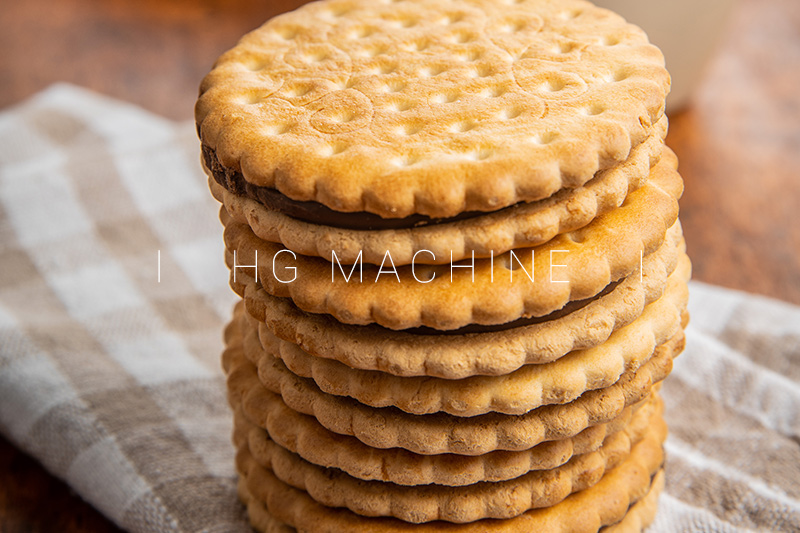
After baking, controlled cooling is essential to prevent condensation and structural breakage. Cooling conveyors gradually reduce biscuit temperature before downstream handling. For sandwich biscuits, automated creaming machines apply precise amounts of filling, ensuring consistent weight and alignment at high speeds.
Automated Packaging and Line Integration
Packaging systems in a biscuit production line are designed to protect product integrity while maintaining throughput. Horizontal flow wrappers, tray packers, and secondary cartoning machines are commonly synchronized with upstream processes. Integrated checkweighers and metal detectors enhance quality control without interrupting production flow.
Energy Efficiency and Production Optimization
Modern biscuit production lines focus heavily on energy optimization and operational efficiency. Heat recovery from ovens, variable frequency drives on motors, and real-time production monitoring systems help reduce operating costs. These improvements not only lower energy consumption but also improve overall equipment effectiveness and product consistency.
Choosing the Right Biscuit Production Line Configuration
Selecting the appropriate biscuit production line depends on product variety, target capacity, and future scalability. Manufacturers should evaluate flexibility, automation level, hygiene design, and after-sales support when investing in a new line. A well-matched configuration ensures long-term productivity, stable quality, and the ability to respond quickly to changing market demands.

Copyright Shanghai HG(hengguang) Food Machinery Co.,Ltd. All Rights Reserved
