 English
Frozen french fries manufacturing process
The humble french fry, a global fast-food staple, is a product of a highly complex and precise Frozen French Fries Manufacturing Process. Producing the millions of tons of uniform, pre-cooked, and perfectly preserved fries sold worldwide requires a sophisticated industrial operation, primarily relying on specialized equipment known collectively as the frozen french fries machine assembly line.
Step 1: Receiving and Preparation (The Raw Potato)
The process begins with selecting the right raw material. Manufacturers primarily use high-solid potato varieties, because their high starch content yields the desired fluffy interior and crispy texture.
-
Washing and Sorting: Potatoes are rigorously washed to remove soil and debris. They are then sent to sorting equipment where any sub-standard potatoes (too small, green, or bruised) are removed, ensuring only the highest quality potatoes enter the production line.
-
Peeling: Industrial lines use either steam peelers (which use high-pressure steam to loosen the skin quickly and efficiently) or abrasive peelers. The efficiency of the peeling stage minimizes waste and sets the standard for the entire process.
Step 2: Precision Cutting and Rinsing
This stage is critical for ensuring the uniformity that consumers expect. Uniform size is essential for consistent cooking and freezing times.
-
Cutting: Peeled potatoes are fed into a powerful hydro-cutter, a specialized component of the frozen french fries machine. This device uses a high-pressure jet of water to shoot the potato through a grid of sharp blades, resulting in quick and perfectly uniform sticks (typically 6x6mm, 9x9mm, or crinkle-cut).
-
Rinsing: The newly cut strips immediately pass through a rinsing machine to wash away the free starch on the surface. Removing this starch is crucial; if left on, it would cause the fries to stick together and burn during frying.
Step 3: Blanching and De-Watering (The Pre-Cook)
Blanching is arguably the most vital step in determining the final quality and shelf life of the frozen product.
-
Blanching: The potato strips are submerged in hot water (around to ) for a carefully controlled duration. This process serves three key functions:
-
Deactivating Enzymes: It deactivates enzymes that would otherwise cause browning or discoloration during storage.
-
Reducing Sugar: It washes away reducing sugars, which would cause the fries to develop an undesirable dark color during the final frying stage.
-
Gelatinizing Starch: It partially pre-cooks the interior, ensuring a soft center when the final product is reheated.
-
-
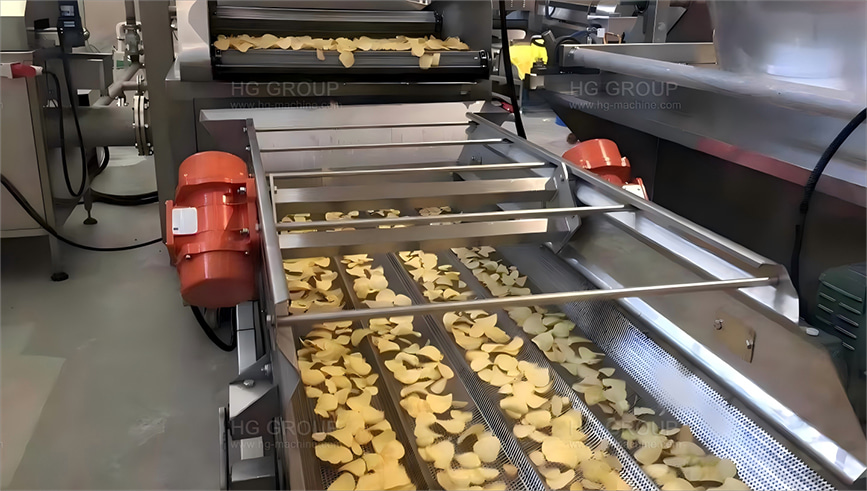
Drying/De-Watering: After blanching, the strips are passed through a vibrating de-watering machine or air knife system. Removing surface moisture before frying is paramount. Excessive moisture would lower the oil temperature and lead to soggy, oily fries.
Step 4: Par-Frying
The potatoes are now ready for their first encounter with oil.
-
Continuous Frying: The strips enter a large-scale, automated continuous frying machine (a central piece of the frozen french fries machine line). They are partially fried, or "par-fried," in vegetable oil for a very short time. This process sets the surface crust, develops the signature golden color, and further dehydrates the fries, locking in the pre-cooked structure.
-
De-oiling: Immediately after frying, the fries pass through a vibrating de-oiling conveyor to remove excess surface oil, contributing to a healthier and better-tasting final product.
Step 5: Freezing and Packaging (The Final Preservation)
The final transformation from hot, par-fried strips to shelf-stable frozen products occurs here.
-
Quick Freezing (IQF): The fries are cooled and then rapidly frozen using an Individual Quick Freezing (IQF) tunnel. This advanced frozen french fries machine uses extremely low temperatures (often to ) to freeze each fry individually and quickly. Rapid freezing is essential as it forms smaller ice crystals, minimizing damage to the cell structure and preserving the taste and texture when cooked by the consumer. The core temperature is typically brought down to at least .
-
Weighing and Packaging: Finally, the frozen fries are automatically conveyed to a multi-head weighing and packaging machine. The machine weighs the precise amount, bags the product, and seals it for distribution to stores and restaurants around the world.
The efficiency and sophistication of this automated production line—the ultimate frozen french fries machine—is what allows for the mass production of a consistently high-quality, convenient, and safe food product enjoyed globally.

Copyright Shanghai HG(hengguang) Food Machinery Co.,Ltd. All Rights Reserved
